FFL Ecommerce
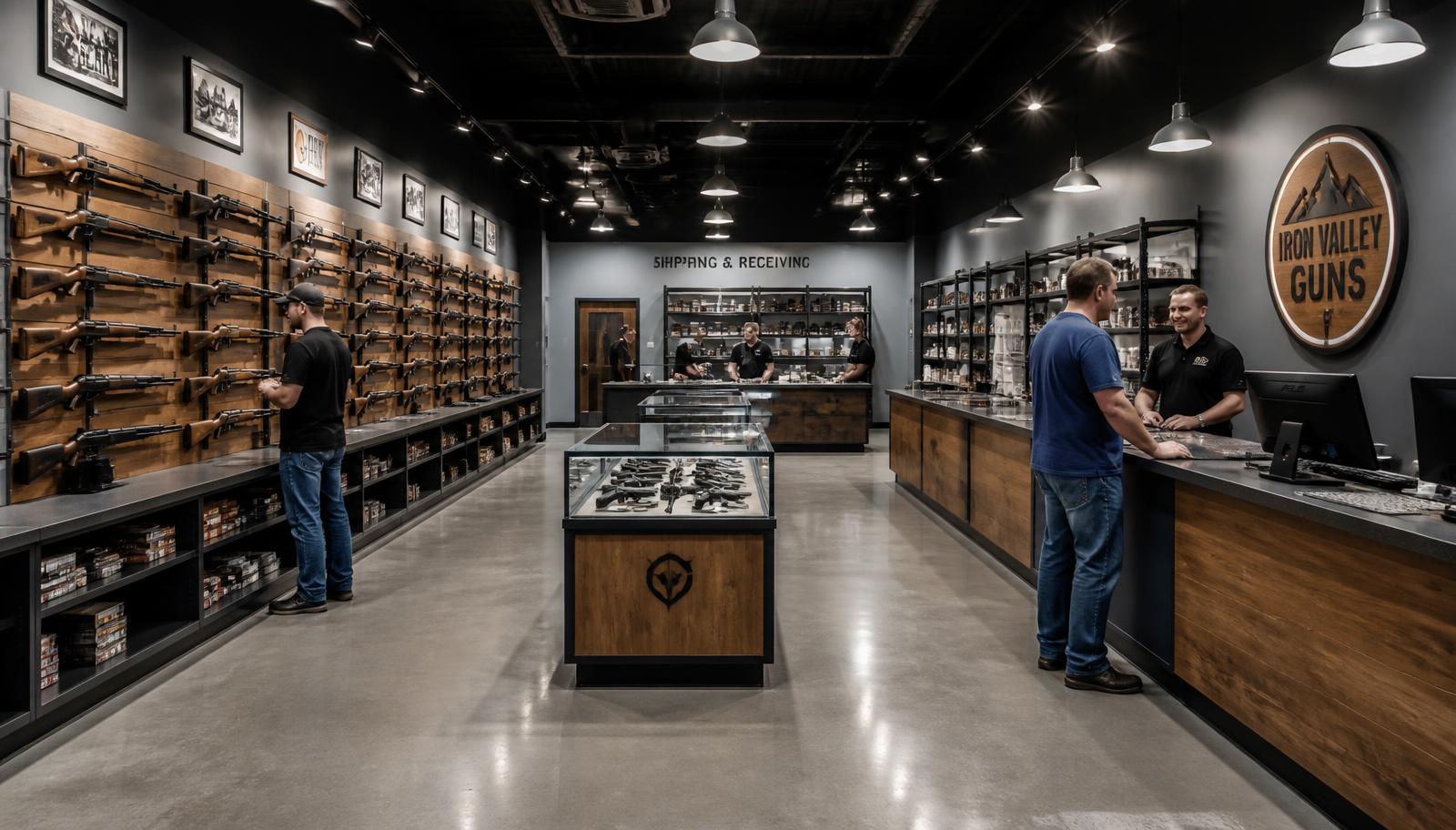
The full online workflow: catalog, cart, dealer capture, sourcing, shipment and customer communication for firearm and non-firearm items together.
View service →
System 03 — Fulfillment
A firearm ecommerce order does not move from cart to doorstep like a standard retail order. Dealer selection, inventory source, transfer workflow and status communication all sit between the purchase and a completed sale — and generic platforms model almost none of it.
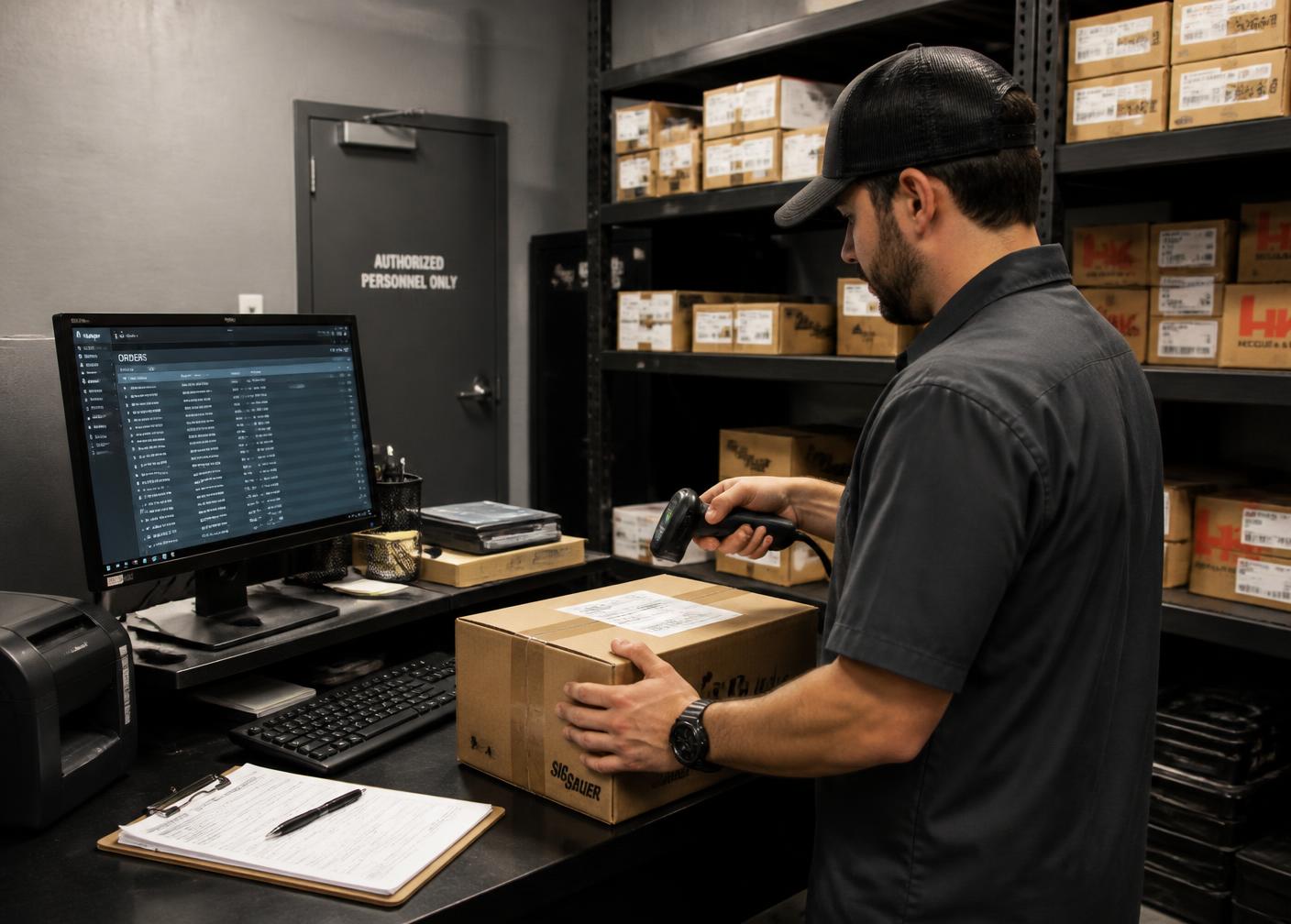
Fulfillment in the store
Inventory truth, distributor availability and FFL transfer steps have to line up before an order can be fulfilled.
Inventory
ConceptualFulfillment path
The gap
Every one of these is a decision point where an order can stall, and each one is a place where staff usually end up filling the gap manually.
Order routing
The branch that generic ecommerce never models: the same order can be filled from your own shelf or drop-shipped from a distributor, and both paths have to end at the same verified destination with the same customer-facing status.
We build technology and workflow, not legal advice. Transfer requirements, record keeping and eligibility are your responsibility and your counsel's — what we do is make sure the systems capture the right information at the right step and hand it to the people who need it.
In practice, most fulfillment failures are information failures: the dealer was captured as free text, the distributor showed stock that was gone, or the order status lived in an inbox instead of the customer's account.
Customer Order
Firearm and non-firearm items in one cart
Product & Inventory Check
Local stock or distributor availability
Payment
Authorized before routing
FFL Destination
Receiving dealer selected and verified
Local Inventory
Pulled, logged and prepared in store
Distributor Inventory
Drop-shipped to the receiving dealer
Ship / Transfer
Tracking, status updates and dealer handoff
Order Complete
Synced back to POS, inventory and CRM
Inside the system
The full online workflow: catalog, cart, dealer capture, sourcing, shipment and customer communication for firearm and non-firearm items together.
View service →Dealer lookup, selection and license information capture as part of the buying experience instead of an email exchange after the sale.
View service →Feed connections for product data, availability and scheduled updates, with mapping rules that keep the catalog coherent.
View service →Pricing, availability and catalog normalization across local stock and distributor stock at feed scale.
View service →Serial-level records connected between store systems and the storefront so a single unit is never sold twice.
View service →Order states from purchase through dealer handoff, including shipping constraints and status visibility for the customer.
View service →Routing, drop-ship submission and exception handling so staff intervene by exception rather than on every order.
View service →One version of stock across the counter and the website, with rules for what is publishable and what is held.
View service →Connections
Fulfillment reads from the payment system — an order should not be routed to a distributor before funds are authorized — and it writes to the operating system, where POS, inventory and reporting have to agree on what happened. It constrains the growth system too: availability accuracy determines whether product pages deserve to be indexed at all.
After delivery, the handoff moves to retention, where transfer history and purchase data drive the accessory, ammunition and training follow-up that makes the first order profitable.
Experience
Where orders stop moving
We trace real orders through the system and find the step where a human has to intervene every time. That step is the constraint, not the software brand.
Feed truthfulness
Availability accuracy is measured against what actually shipped, because a feed that publishes optimistic stock produces cancellations and disputes rather than sales.
Status visibility
Customers call when a system does not tell them anything. Order state modeling reduces support volume more reliably than adding staff.
Multi-location firearm retail · WooCommerce · FFL Cockpit
The product catalog was rebuilt in WooCommerce so serialized firearms, accessories and ammunition each behaved according to their own rules, with location-aware availability instead of a single undifferentiated stock number.
Read the case study →How we report results
We publish what was built and how the business operates afterwards. Client revenue, traffic and ranking figures are only published with the operator's written approval.
All case studies →Compliance and marketplace systems we integrate
Bound-book and compliance software, marketplace order flow and the storefront layer have to agree on inventory before fulfillment works.



Answers
Related systems
Proof
Documented implementations — what was built and how the business runs afterwards. No modelled or estimated performance figures.
Multi-location firearm retail · WooCommerce · FFL Cockpit
The product catalog was rebuilt in WooCommerce so serialized firearms, accessories and ammunition each behaved according to their own rules, with location-aware availability instead of a single undifferentiated stock number.
Read the case study →Local retail + national ecommerce · WooCommerce · FFL Cockpit
Firearms, ammunition, optics, parts and accessories were structured with consistent taxonomy, attributes and filtering so that a large catalog stays navigable for customers and legible to search engines.
Read the case study →Systems Assessment
We map the path an order takes from checkout to transfer, find the manual steps, and show what can be automated without changing how your store actually works.