Catalog SEO, taxonomy, compatibility data, brand pages and buying-guide content. Owned demand matters more here than in most categories.
- Ecommerce SEO
- Taxonomy
- Content
- CRO
- AI search

Who We Help
Build better product discovery, ecommerce, search visibility and customer retention around large firearm parts and accessories catalogs.
Systems in view
ConceptualThe business model
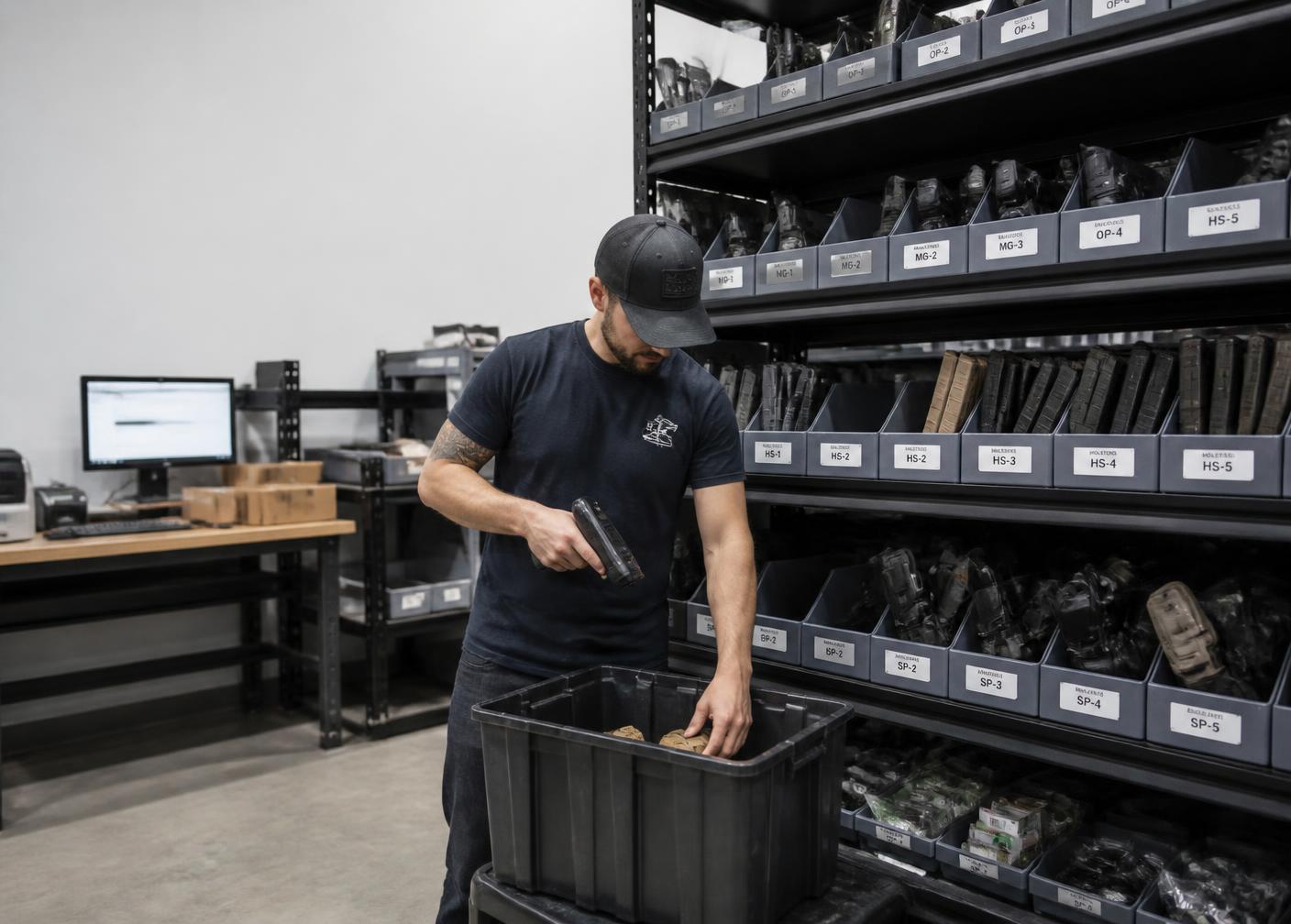
Parts, accessories, optics and components behave much more like conventional ecommerce than firearm sales do. There is no transfer, no receiving dealer and, for most products, no serialization. Order volume is higher, average order value is lower and repeat purchase is far more frequent.
What does carry over is the ecosystem: advertising restrictions, payment processors that treat the category cautiously, and marketplace channels that may not accept the catalog. So the growth engine has to be owned — search, content, email — rather than rented.
Discovery
Category, platform, brand and attribute are all legitimate paths. The catalog has to support them without duplicating itself.
One shopper wants a red dot. Another wants an optic for a specific platform. Another wants a specific manufacturer. Another is filtering by mount type or footprint. All four should land somewhere useful, and none of those landing pages should be a near-copy of the others.
That is a taxonomy and attribute decision made once at the data level, not a series of pages written by hand. Product attributes drive filtering, faceted pages, compatibility statements and internal linking.
By category
By platform
By brand
By attribute
One product record, four indexable paths
Compatibility data is what keeps those paths from turning into duplicate pages.
Ecommerce SEO
Firearms Ecommerce SEO covers each of these in detail, and ecommerce development covers the platform work behind them.
Compatibility
The question behind most accessory purchases is simply "will this fit what I already own?" A catalog that answers it clearly — structured fitment data, honest compatibility notes, and filters that let a buyer start from their platform — converts better and earns search visibility that generic product copy never will.
Compatibility content stays factual: what a product is designed to fit and what it is not. We do not publish modification instructions or workarounds.
Content
Comparison guides
Two or three products a buyer is genuinely deciding between.
Selection resources
How to choose within a category based on use and budget.
Brand guides
What a manufacturer is known for and where its lines differ.
Category education
What a product type does and what the specifications mean.
This content also links directly into the catalog, which is what makes it commercially useful rather than a blog. See content marketing.
The Five Systems
Catalog SEO, taxonomy, compatibility data, brand pages and buying-guide content. Owned demand matters more here than in most categories.
Processing that accepts firearm-adjacent products without surprise holds, plus checkout compatible with high order counts.
Conventional pick, pack and ship — with attention to any restricted or regulated items in the catalog and where they can be shipped.
The strongest lever in this category. Post-purchase sequences, platform-based cross-sell, reactivation and loyalty against a repeatable purchase cycle.
Product data management across thousands of SKUs, integrations with suppliers and reporting by category and platform rather than just totals.
What we usually find
Answers
Related services
Each service page covers the specific implementation detail behind these systems.
Distributor feed duplication, variants, out-of-stock and discontinued product handling.
Platform builds that survive FFL checkout, serialized items and feed volume.
Expert content that earns rankings and citations in the firearms vertical.
Online checkout processing compatible with firearm catalogs.
Deliverability and lifecycle programs for firearm retailers.
Accessory, ammo and training attach after the first sale.
Other business models
Proof
Documented implementations — what was built and how the business runs afterwards. No modelled or estimated performance figures.
Multi-location firearm retail · WooCommerce · FFL Cockpit
Two retail locations, a live firearm catalog and a transfer operation, unified behind one ecommerce, inventory and marketing system instead of three disconnected tools.
Read the case study →Local retail + national ecommerce · WooCommerce · FFL Cockpit
A family-run Wynne, Arkansas retailer running a large national firearms and ammunition catalog — two very different businesses served by a single ecommerce, fulfillment and search architecture.
Read the case study →Systems Assessment
We evaluate your growth, ecommerce, payment, fulfillment, retention and operating systems, then show you where the biggest opportunities are.