
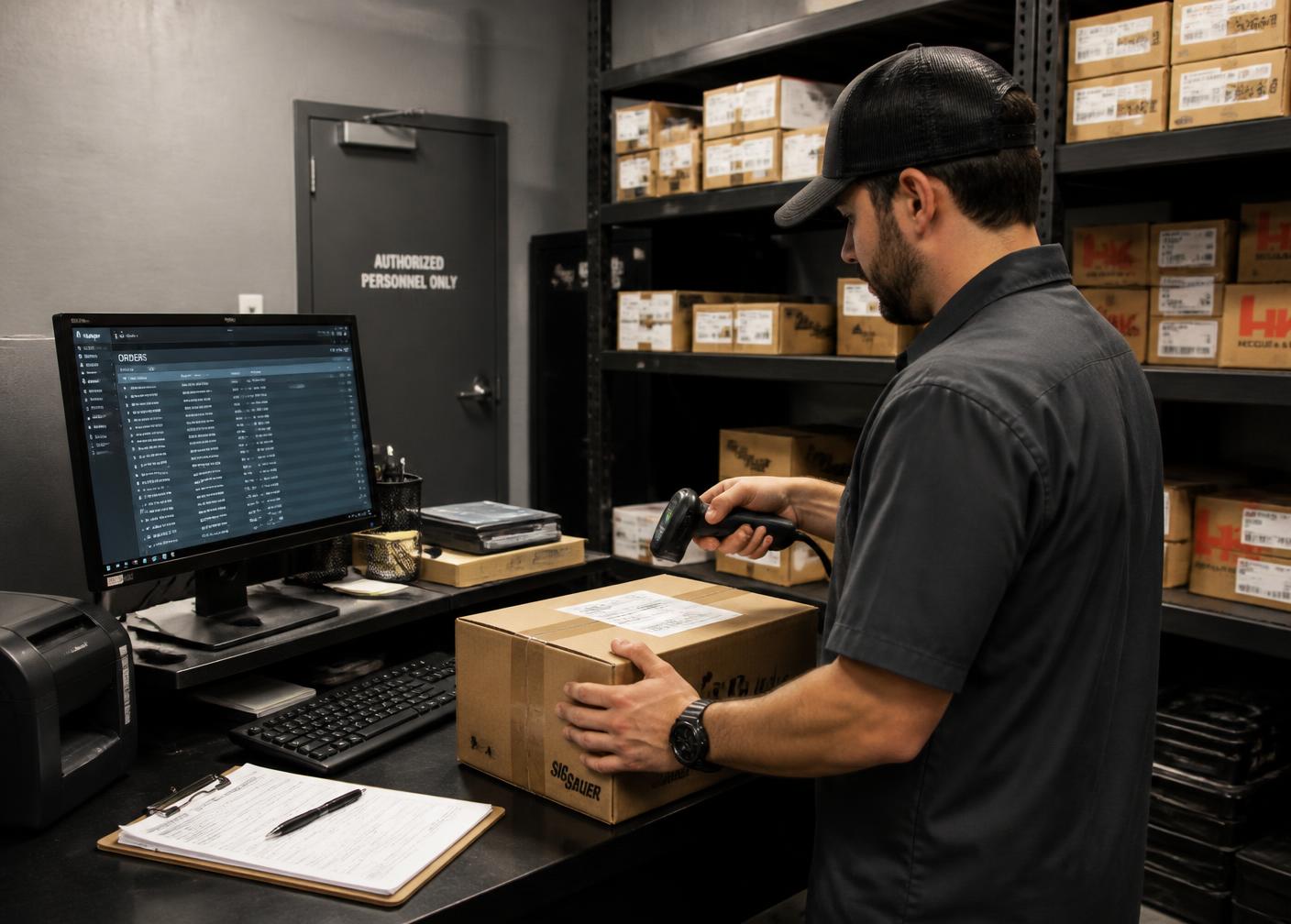
Fulfillment System
FFL Ecommerce Built Around the Transfer
Most firearm ecommerce problems are not design problems. They are order-model problems: the platform assumes a package goes to a doorstep, and the business has to patch the difference with email and phone calls.
Order journey
From product page to completed transfer
One order, two possible sources, one required destination — and a customer who needs to know where it is the whole time.
A working FFL storefront makes three promises it can keep: the item is really available, the dealer the customer chose is really going to receive it, and the status they see is really the status of the order. Break any one of those and support volume climbs faster than sales do.
We build to that standard first and treat visual design as the layer on top, because a beautiful store that oversells stock produces refunds and disputes rather than repeat customers.
Product page
Firearm flagged, availability truthful
Cart & checkout
Mixed cart split by handling rules
Dealer capture
Receiving FFL attached to the order
Local stock
Pick, pack, ship from the store
Distributor
Drop-ship to the receiving dealer
Transfer at dealer
Customer notified, handoff recorded
Scope
What we build into a firearm storefront
The pieces generic platforms leave to plugins, spreadsheets or staff memory.
Firearm product flags
Item-level handling rules that drive checkout behavior automatically.
Dealer capture
Receiving FFL selected and stored as structured data on the order.
Mixed cart handling
Split shipments and split messaging without duplicate orders.
Availability truth
Local, distributor and committed stock resolved into one sellable number.
Authorization timing
Coordinated with the payment system so funds and fulfillment agree.
Transfer states
Order lifecycle modeled through the dealer handoff, not just shipping.
Customer notifications
Status changes that reduce phone calls instead of creating them.
Restricted destinations
Rules applied by product and location before checkout, not after.
Reporting
Sales, cancellations and transfer completion visible as one picture.
Method
How we build FFL ecommerce
- 01
Order model
Define the states a firearm order passes through before it is finished.
- 02
Catalog rules
Which products are buyable online, which are inquiry-only, which are hidden.
- 03
Checkout design
Dealer capture, mixed-cart handling and expectations set before payment.
- 04
Sourcing logic
Local stock versus distributor, decided by rules rather than by whoever opens the order.
- 05
Status and notifications
Every state change visible in the customer account and in the inbox.
- 06
Operational handoff
Staff runbook, exception queue and reporting that reflects reality.
Storefront work depends on the payment system for authorization and capture timing, on distributor feeds for catalog depth, and on POS synchronization so the counter and the website never sell the same unit twice.
Experience
What we check before writing any code
Cancellation rate
Orders cancelled after purchase are the clearest measure of catalog honesty.
Manual touches per order
Count them. Each one is a workflow the platform never modeled.
Support themes
The three questions customers ask most are usually three missing status states.
Dealer data quality
Free-text dealer fields produce shipping errors that are expensive to fix.
Multi-location firearm retail · WooCommerce · FFL Cockpit
Armory 219
The product catalog was rebuilt in WooCommerce so serialized firearms, accessories and ammunition each behaved according to their own rules, with location-aware availability instead of a single undifferentiated stock number.
Read the case study →How we report results
We publish what was built and how the business operates afterwards. Client revenue, traffic and ranking figures are only published with the operator's written approval.
All case studies →Answers
Common questions
- Can gun stores sell firearms online?
- Firearm retail online generally means the sale is completed through a licensed dealer rather than shipped to the buyer, and the applicable rules depend on the products, the parties and the jurisdictions involved. We build the systems that capture the dealer, route the shipment and record the workflow; compliance requirements are yours and your counsel's to define.
- What makes FFL ecommerce different from normal ecommerce?
- The order does not end at the buyer's address. A receiving dealer becomes part of the order record, the item may be sourced from a distributor rather than your shelf, and the order stays open through a transfer window that can last days or weeks.
- Can a cart contain both firearms and accessories?
- Yes, but the two halves of the order behave differently: one ships to a dealer, the other ships to the customer. If the platform cannot split handling and communicate it clearly, staff end up untangling every mixed order by hand.
Proof
This work, in real firearm businesses
Documented implementations — what was built and how the business runs afterwards. No modelled or estimated performance figures.
Multi-location firearm retail · WooCommerce · FFL Cockpit
Armory 219
The product catalog was rebuilt in WooCommerce so serialized firearms, accessories and ammunition each behaved according to their own rules, with location-aware availability instead of a single undifferentiated stock number.
Read the case study →Local retail + national ecommerce · WooCommerce · FFL Cockpit
USA Gun Store
Firearms, ammunition, optics, parts and accessories were structured with consistent taxonomy, attributes and filtering so that a large catalog stays navigable for customers and legible to search engines.
Read the case study →
Systems Assessment
Make the storefront match the workflow
We map how firearm orders move through your business today, then build the ecommerce layer around that reality instead of a generic cart.