Skip to content
Gun Store Systems

Who We Help

Business Systems for Modern Gun Stores

Connect the systems behind customer acquisition, retail, ecommerce, payments, inventory, fulfillment and repeat business without managing each one as a separate project.

  • Growth
  • Payment
  • Operating
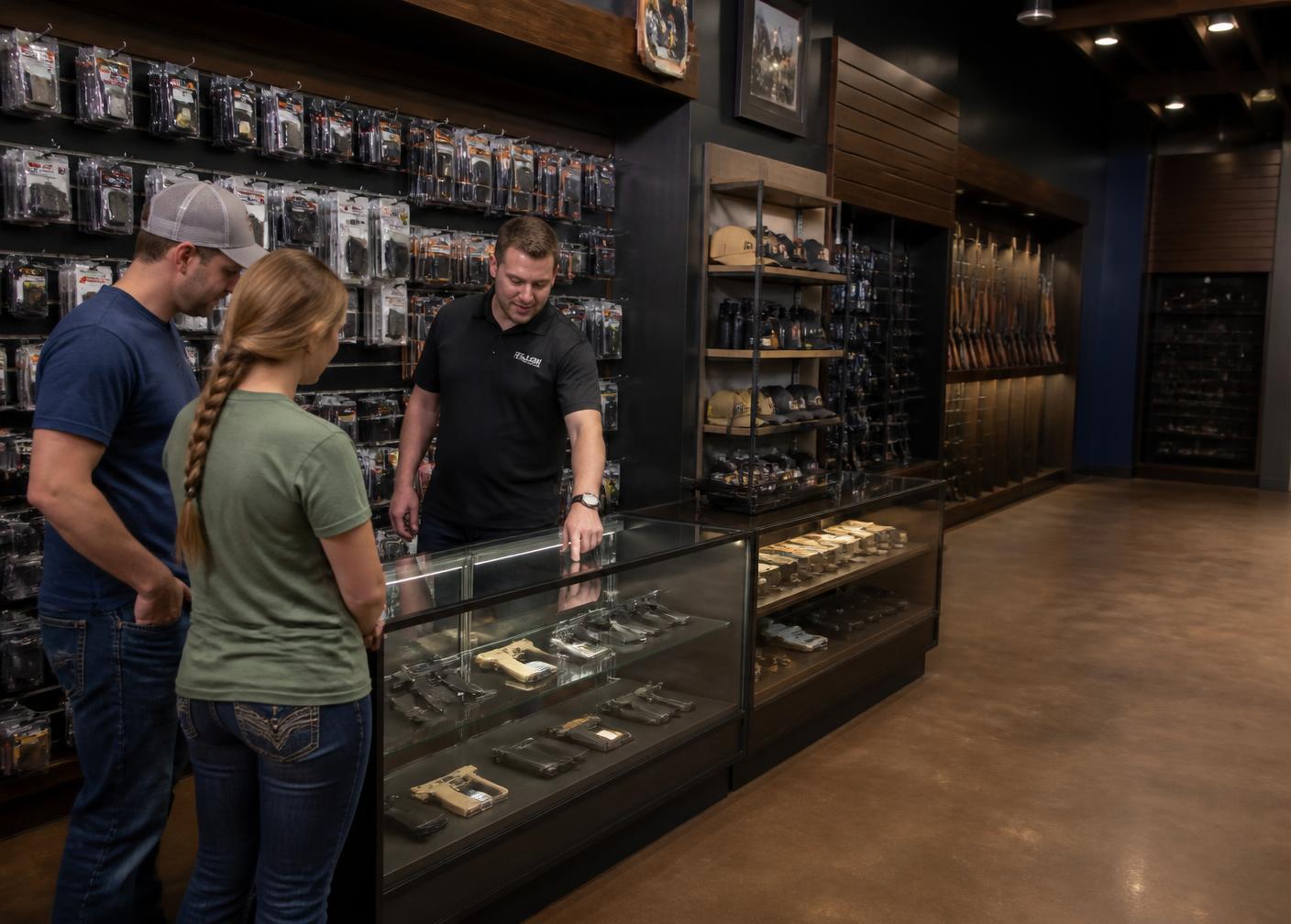
Employee helping customers at a display case inside a modern gun store

Systems in view

Conceptual
POS
Connected
Local search
Listed
Inventory
Synced
Retail floor and counter

The business model

A modern gun store is more than a retail counter

The stores doing well right now are running several businesses at once. There is the retail floor: counter sales, transfers, special orders, accessories and ammunition. There is a digital storefront that customers check before they drive over. There is a distributor relationship feeding a catalog far larger than the shelf. And there is a customer list that most stores never use.

Each of those pieces usually arrived separately — a website from one vendor, a point of sale from another, a payment processor sold over the phone, a distributor feed switched on because it was available. Individually, they work. Together, they leak. Staff bridge the gaps manually, the website drifts out of sync with the counter, and nobody can answer a simple question like "what did we sell to this customer last year?" without opening three tools.

Our work in a gun store is rarely one project. It is deciding which system is currently costing the most, fixing that, and making sure the fix connects to everything downstream of it.

The Five Systems

How the Five Systems apply to a gun store

Retail stores usually lead with Growth and Operating, because visibility and the counter stack are where the money either arrives or disappears.

Most gun store demand is local and intent-driven: someone already wants a specific firearm, transfer or class and is deciding where to go. Visibility across map results, organic search and AI answers is the first system.

  • Local SEO
  • Gun store SEO
  • Website design
  • Ecommerce
  • AI search
  • Content

A store often needs card-present processing at the counter and a separate, firearm-compatible path for online orders. Both need underwriting that understands what the business actually sells.

  • Retail processing
  • Ecommerce payments
  • Gateway
  • POS payments

Inventory accuracy is the whole game. What the shelf holds, what the distributor can drop-ship and what the website advertises need to be reconcilable, and outbound firearm orders need a dealer workflow.

  • Inventory
  • Distributor integrations
  • FFL ecommerce
  • Dealer workflows
  • POS sync

Gun store customers buy repeatedly — ammunition, accessories, range time, the next firearm. Very few stores communicate with the list they already own.

  • Email
  • CRM
  • Reactivation
  • Loyalty
  • Post-purchase

The point of sale is the system of record for a retail store. Everything else should be judged by how cleanly it connects to it, and by whether the owner can get a straight answer out of reporting.

  • POS
  • Integrations
  • Hosting
  • Reporting
  • Automation

What we usually find

What we usually find inside gun stores

These are the recurring patterns, not a hypothetical list.

  • The website advertises products the store does not have and cannot get quickly.
  • Point of sale and ecommerce are disconnected, so pricing and stock diverge within days.
  • Distributor data lands in the catalog untouched, producing thousands of near-identical product pages.
  • Local search presence is thin: incomplete profiles, no service pages, no review cadence.
  • The customer database exists but nothing is ever sent to it.
  • Payment setup was built for retail and does not extend cleanly to online orders.
  • Staff move information between platforms by hand every day.
  • Reporting is fragmented across POS, website analytics and the processor's dashboard.

Local and online

Most gun stores need both lanes running

A store does not choose between local retail and ecommerce. It chooses whether the two share the same data.

The local lane starts in map results and ends at the point of sale. The online lane starts in search or an AI answer and ends in a shipment to a receiving dealer. Both lanes touch inventory, both create a customer record, and both should feed the same follow-up.

When the lanes are separated, the symptoms are predictable: online orders for items already sold at the counter, in-store customers who never enter the email list, and reporting that cannot tell you which channel a customer actually came from.

Two lanes, one inventory and one customer record

Local customer

Maps & local search

Storefront visit

Counter sale

POS record

Online customer

Search or AI answer

Ecommerce catalog

Payment

Ship to FFL

Both lanes should write to the same inventory count, the same pricing rules and the same customer record. Most stores we review keep them in two systems that never speak.

Where to start

Sequencing matters more than scope

A store with weak local visibility should not be rebuilding its checkout. A store with an accurate counter and an inaccurate website should fix the data before adding traffic to it. That sequencing is the point of the Systems Assessment: find the constraint first, then spend money on it.

Answers

Gun store systems questions

What systems does a modern gun store need?
At minimum: a website and local search presence that brings customers in, a payment setup that works at the counter and online, inventory that reflects what is actually on the shelf, a way to reach past customers again, and a point of sale that connects to the rest of it instead of standing alone.
Does a gun store need ecommerce if most sales happen in the store?
Most stores we review get value from online product visibility long before they get value from online checkout. Customers research online and buy at the counter. Whether full ecommerce makes sense depends on catalog access, staffing and shipping workflow — it is a business decision, not a default.
Why do gun store websites show inventory the store does not have?
Usually because the website catalog is fed by a distributor file while the counter runs on point-of-sale data, and nothing reconciles the two. Fixing it is an inventory and integration problem, not a website design problem.

Systems Assessment

Find the weakest link in your gun store

We evaluate your growth, ecommerce, payment, fulfillment, retention and operating systems, then show you where the biggest opportunities are.