System 05 — Operating
The Operating System Behind a Modern Gun Store
This is not a product. 'Operating System' is how we describe the connected technology infrastructure behind a firearm business — POS, ecommerce, inventory, CRM, payments, hosting, analytics and automation working as one stack instead of eight vendors.
- POS
- Hosting
- IT
- Security
- Automation
- Integrations
Operating in the store
The layer every other system runs on
POS, ecommerce, inventory, payments and reporting only behave like one business when the connections are deliberate.
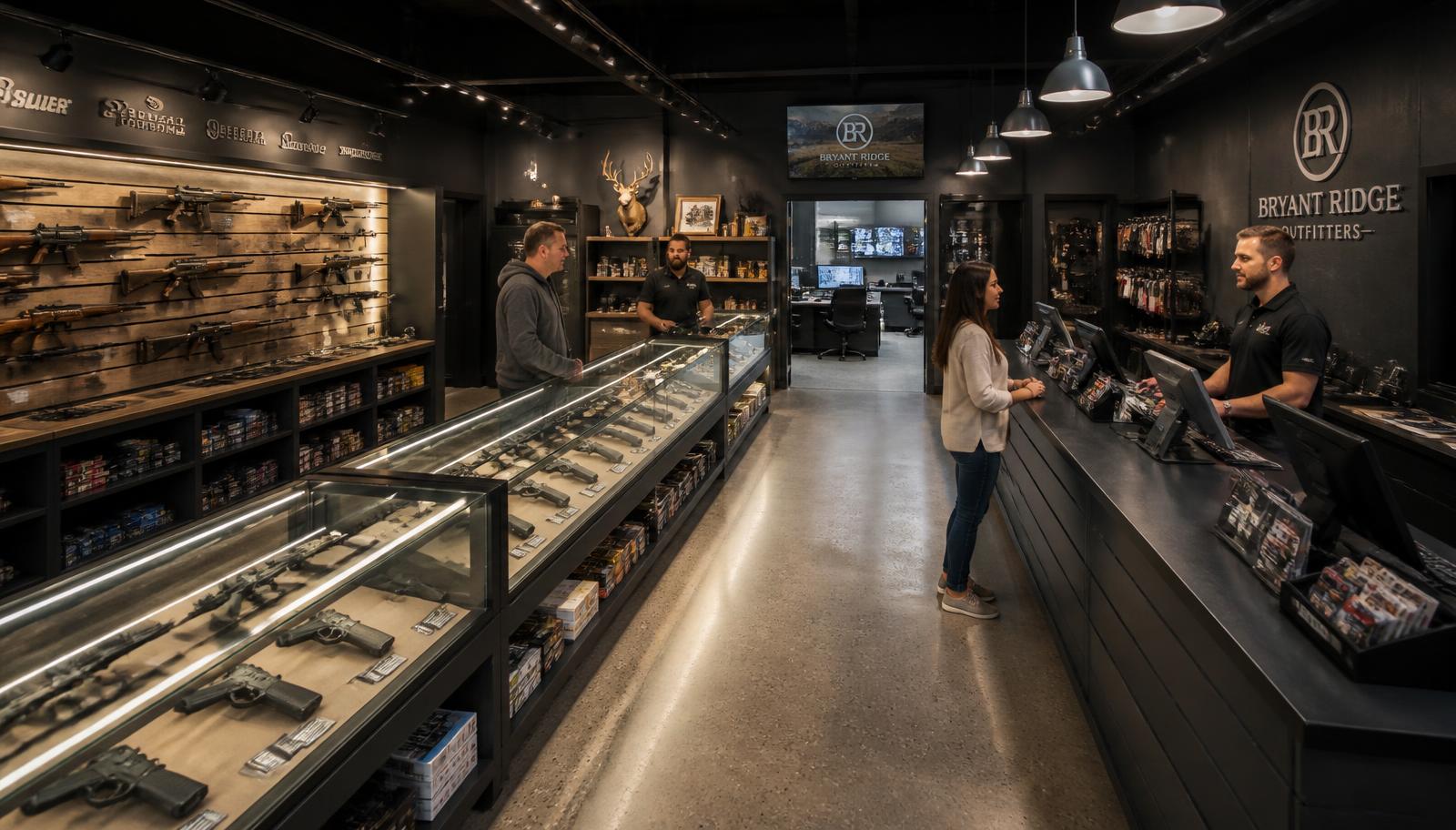
Counter
Conceptual- POS
- Online
- Payments
- Connected
Operating System
- POS
- Ecommerce
- Inventory
- CRM
- Hosting
- Automation
Infrastructure
Everything else runs on this layer
Growth, Payment, Fulfillment and Retention each assume the infrastructure beneath them is reliable. When it is not, every one of them degrades at once — and the symptoms show up as marketing, payment or fulfillment problems.
A gun store typically accumulates its stack over a decade: a POS chosen for the counter, a website added later, a feed connection bolted on when ecommerce grew, a processor swapped after a freeze, and reporting assembled in a spreadsheet because none of it agreed.
The work here is rarely a rip-and-replace. It is establishing which system is authoritative for each kind of data, connecting them deliberately, and monitoring the connections so a broken integration is noticed by software rather than by a customer.
Growth
Business system
Payment
Business system
Fulfillment
Business system
Retention
Business system
Operating System
Systems of record, integrations, infrastructure and monitoring
POS
Ecommerce
Payments
Inventory
FFL software
CRM
Distributors
Hosting
Analytics
Automation
The Operating System connects and supports everything
Inside the system
What the Operating System includes
Ten services in three groups: the platforms you sell on, the infrastructure beneath them, and the data layer that makes both measurable.
Core retail technology
The platforms transactions actually happen on, and the connections between them.
Gun Store POS Systems
Selection, migration, configuration and optimization of firearm retail POS platforms. We integrate and support POS software — we do not sell our own.
View service →FFL Software Integration
Connecting specialized firearm software to commerce systems so records are not rebuilt by hand.
View service →Ecommerce / POS Integration
The full relationship between storefront and counter: catalog, pricing, orders, customers and reporting.
View service →Infrastructure
What the storefront runs on, and what happens when something goes wrong.
Managed Website Hosting
Hosting sized for large firearm catalogs, feed imports and traffic spikes around releases and holidays.
View service →IT Services for Gun Stores
Business technology support, platform troubleshooting and vendor coordination across the stack.
View service →Website Security
Hardening, access control, controlled updates and monitoring for storefronts that take orders.
View service →Backup & Disaster Recovery
Tested restores — backups that have never been restored are assumptions.
View service →Data & automation
Turning a connected stack into reporting and workflows the business can act on.
Analytics & Reporting
Reporting across web, counter and range that reconciles instead of producing three different answers.
View service →Business Automation
Removing the manual re-keying between systems that quietly consumes staff hours every week.
View service →Systems Integration
The flagship service: systems of record, data flow mapping and monitored connections across the whole stack.
View service →Symptoms
Your software stack should work like one system
These problems are usually blamed on a platform. More often they are seam problems between platforms that were each doing their own job.
What we typically find
- Duplicate inventory records between web and counter
- Manual data entry repeated across two or three systems
- Disconnected reporting that never reconciles
- Mismatched customer data with no single record
- Website and POS quantities that disagree by the hour
- Integrations nobody owns or monitors
- Hosting that slows down exactly when traffic arrives
- Backups that have never been test-restored
- Automations that broke after an update and were never noticed
What we build toward
- One authoritative source for each data type
- Automated exchange instead of re-keying
- Reporting that reconciles across channels
- A unified customer record
- Stock accuracy the storefront can safely publish
- Monitored integrations with alerting
- Hosting sized for catalog and feed load
- Recovery that has actually been tested
- Automation with visible failure states
Connections
How the other four systems depend on this one
Growth depends on site speed, uptime and accurate availability data before a product page is worth indexing. Payment depends on gateway and POS integration to keep one ledger. Fulfillment depends on inventory truth and order automation to move an order without manual intervention. Retention depends on a clean customer record to segment at all.
That is why the Operating System is drawn beneath the other four rather than beside them — it is the only system whose weaknesses are inherited by everything else.
Experience
How we approach a technology stack review
Platform-neutral by default
We are not trying to move you off software that works. Most reviews end with fewer replacements and more integration and configuration work than owners expect.
Data ownership mapped explicitly
For products, stock, customers, orders and prices, one system is named authoritative and the others follow. Ambiguity here is the root of most sync problems.
Failure modes documented
What happens when the feed is late, the POS is offline, or the host has an incident — and who finds out first.
Multi-location firearm retail · WooCommerce · FFL Cockpit
Armory 219
FFL Cockpit was integrated as the system of record for bound-book and transfer workflow, so ecommerce activity and compliance-side operations stopped being maintained as two separate manual processes.
Read the case study →How we report results
We publish what was built and how the business operates afterwards. Client revenue, traffic and ranking figures are only published with the operator's written approval.
All case studies →The systems we connect and maintain
Compliance software, storefront and hosting layer are operated as one stack rather than separate vendors.



Answers
Technology questions we get asked
- What software does a gun store need?
- At minimum: a POS that handles firearm retail and required record keeping, an ecommerce platform, an inventory source of truth, payment processing, a customer database and reporting. The list matters less than whether those systems exchange data reliably.
- How do gun store POS and ecommerce systems connect?
- Through an integration that maps products, stock and orders between them, usually on a schedule or through webhooks. The hard parts are matching catalogs that were built independently and deciding which system is authoritative for stock.
- What is an FFL software integration?
- Connecting compliance and bound book software to the systems where sales actually happen, so records and inventory events do not depend on someone re-entering them by hand at the end of the day.
- Is the Operating System a product you sell?
- No. It is our term for the connected technology infrastructure behind a firearm business. We select, integrate, host, secure and maintain that stack — we do not manufacture a POS platform.
Related systems
The systems this layer supports
Retention depends on it too — every system does.
Proof
This work, in real firearm businesses
Documented implementations — what was built and how the business runs afterwards. No modelled or estimated performance figures.
Multi-location firearm retail · WooCommerce · FFL Cockpit
Armory 219
FFL Cockpit was integrated as the system of record for bound-book and transfer workflow, so ecommerce activity and compliance-side operations stopped being maintained as two separate manual processes.
Read the case study →Local retail + national ecommerce · WooCommerce · FFL Cockpit
USA Gun Store
A family-run Wynne, Arkansas retailer running a large national firearms and ammunition catalog — two very different businesses served by a single ecommerce, fulfillment and search architecture.
Read the case study →
Systems Assessment
Review Your Technology Stack
We document what you run, how it connects, where data disagrees and what is unmonitored — then prioritize the fixes with the highest operational return.