
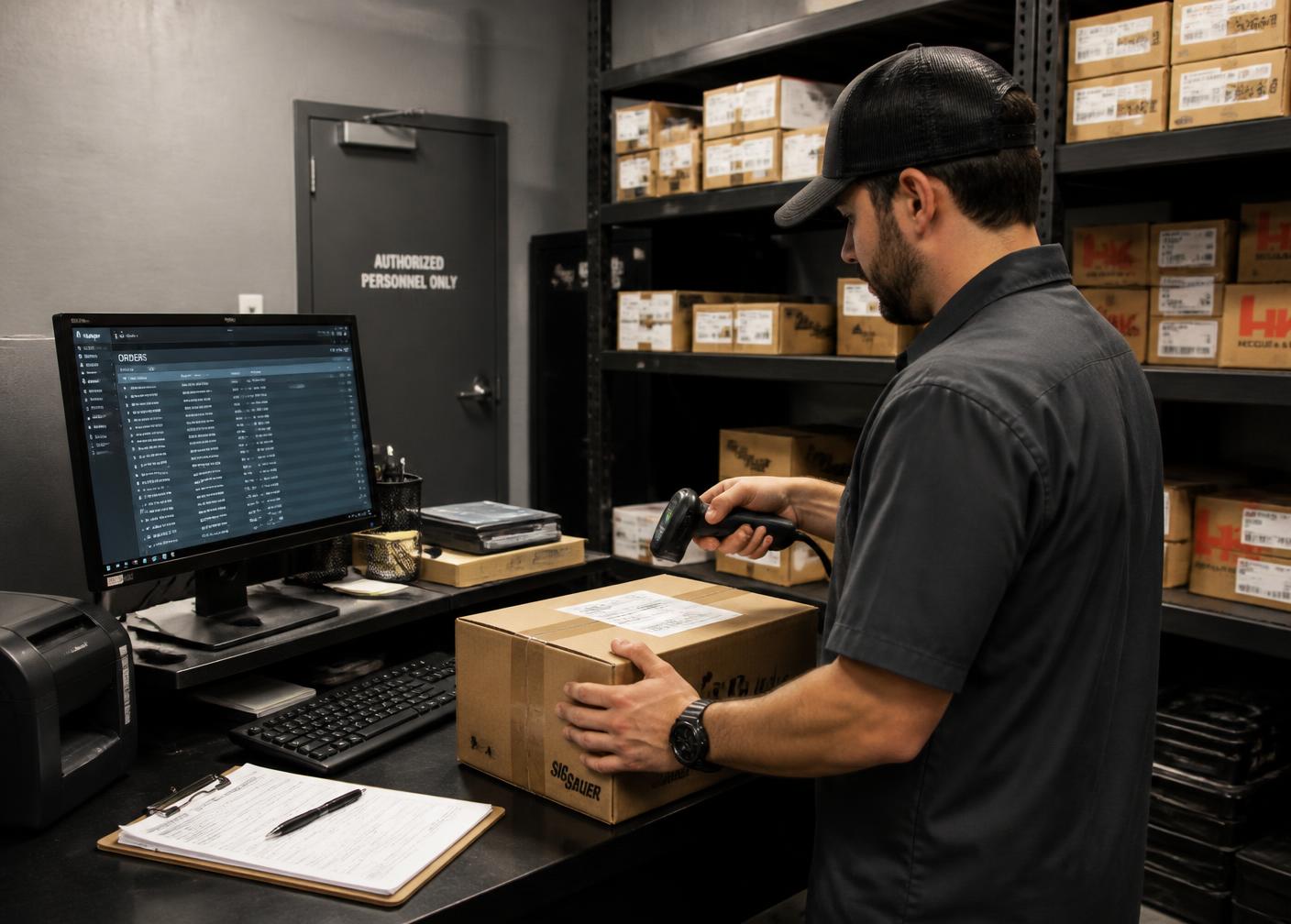
Fulfillment System
Firearm Inventory Integration
Availability is the most consequential number on a firearm storefront. Get it wrong upward and you cancel orders; get it wrong downward and you leave revenue on the shelf.
Availability model
Several sources, one sellable number
Sellable quantity is a calculation with rules behind it, not a column copied from whichever system was easiest to read.
Firearm retail complicates this because serialized units, distributor snapshots and counter sales all move at different speeds. A rifle sold at the counter at 10am should not still be buyable online at noon, and a distributor showing four units should not translate into an unconditional promise.
We define the calculation explicitly, implement it in one place, and make every channel read it — instead of letting each integration invent its own answer.
Store stock
Counted, on the shelf
Distributor stock
Reported, time-delayed
Committed
Held by open orders
Sellable quantity
One number the storefront can promise
Publish
Buyable, indexable, priced
Hold
Hidden or backorder-only
Scope
What inventory integration covers
Pricing and availability are the same project; separating them is how channels drift apart.
Sellable calculation
On hand minus committed, plus qualified external stock.
Committed stock
Open orders, layaway and holds removed from what the site can sell.
Category buffers
Different thresholds for ammunition, optics and serialized firearms.
Price normalization
One price policy across counter and web, with intentional exceptions.
MAP handling
Rules applied where manufacturer pricing policies require them.
Backorder states
Honest 'available to order' instead of a false in-stock claim.
Low-stock behavior
What happens at one unit remaining, decided deliberately.
Catalog normalization
One product record even when three sources describe it.
Audit tooling
Reports comparing published availability against what actually shipped.
Method
How we build the availability layer
- 01
Source inventory
Every system that believes it knows stock, listed and ranked by authority.
- 02
Define sellable
The formula: on hand, minus committed, plus qualified distributor stock.
- 03
Buffers and thresholds
Per-category rules that reflect real sell-through, not one global number.
- 04
Pricing alignment
Cost, margin and promotions resolved so channels do not disagree.
- 05
Publish logic
What becomes buyable, backorderable or hidden at each availability level.
- 06
Measurement
Cancellation and oversell rate tracked after launch, then tuned.
Availability depends on distributor feeds upstream and on POS synchronization for owned stock, and it is the precondition for serialized inventory to work at all.
Experience
How we validate an inventory integration
Oversell rate
Orders placed for items that could not be filled, measured weekly by category.
Shadow testing
Published availability compared against actual fulfillment before go-live.
Latency budget
How long a sale can take to propagate across channels, agreed in advance.
Single owner
One system designated authoritative per stock type; ties are decided, not negotiated at runtime.
Multi-location firearm retail · WooCommerce · FFL Cockpit
Armory 219
The product catalog was rebuilt in WooCommerce so serialized firearms, accessories and ammunition each behaved according to their own rules, with location-aware availability instead of a single undifferentiated stock number.
Read the case study →How we report results
We publish what was built and how the business operates afterwards. Client revenue, traffic and ranking figures are only published with the operator's written approval.
All case studies →Answers
Common questions
- What is inventory integration for a gun store?
- Connecting the places that know about stock — the point of sale, the warehouse, distributor feeds and open orders — so the website publishes one sellable quantity instead of guessing from a single source.
- Why does the website show items that are out of stock?
- Usually because availability is read from one source that is either delayed or does not account for committed units. Fixing it means defining sellable quantity as a calculation, not a field copied from a feed.
- Should distributor stock be shown as in stock?
- Only with rules. Many stores publish distributor items with a longer handling window and a buffer, and hold anything below a threshold. What matters is that the promise on the product page matches what actually happens.
Proof
This work, in real firearm businesses
Documented implementations — what was built and how the business runs afterwards. No modelled or estimated performance figures.
Multi-location firearm retail · WooCommerce · FFL Cockpit
Armory 219
The product catalog was rebuilt in WooCommerce so serialized firearms, accessories and ammunition each behaved according to their own rules, with location-aware availability instead of a single undifferentiated stock number.
Read the case study →Local retail + national ecommerce · WooCommerce · FFL Cockpit
USA Gun Store
Firearms, ammunition, optics, parts and accessories were structured with consistent taxonomy, attributes and filtering so that a large catalog stays navigable for customers and legible to search engines.
Read the case study →
Systems Assessment
Publish stock you can actually ship
We define sellable quantity for your business, implement it once, and make every channel read the same number.