
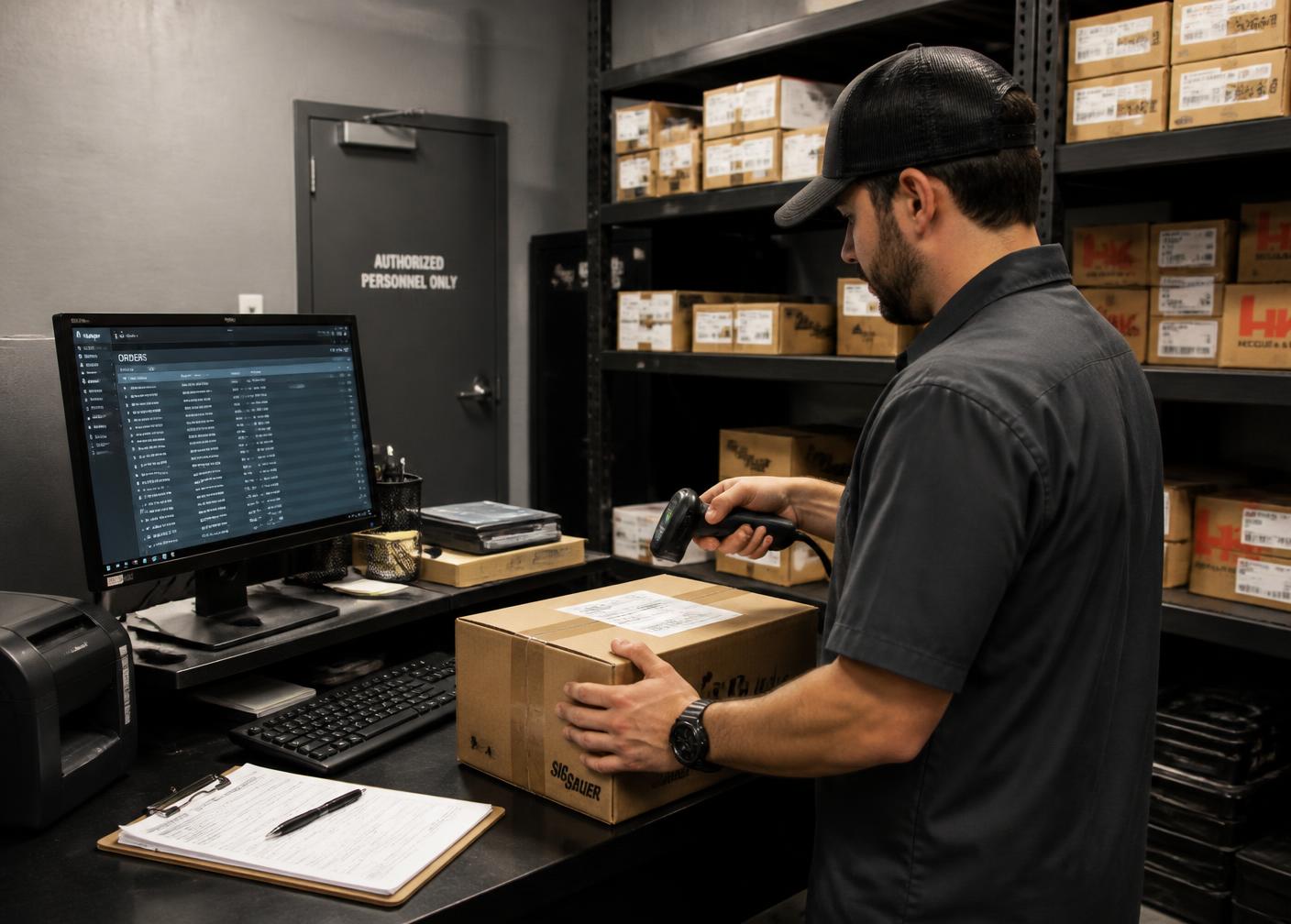
Fulfillment System
Serialized Inventory Integration
Serialized units break the assumptions generic ecommerce makes about stock. Handling them properly is what lets a store sell used, consignment and single-unit inventory online without cancellations.
Unit lifecycle
One unit, one path, one record
From receipt to transfer, a serialized unit should have exactly one status that every channel respects.
Used and consignment firearms are where this matters most. Each one is genuinely unique — condition, photos, price — and each one is a listing that must disappear the instant it is committed, whether that happens online or at the counter.
Our role is the systems integration: the unit record, the reservation behavior and the propagation between channels. Your bound-book and record-keeping obligations remain yours, defined with your counsel; we make sure the operational systems around them stay consistent.
Receipt into inventory
Serial recorded against the SKU
Single unit reserved
Quantity of one, locked to an order
Shipment or counter sale
Serial travels with the record
Transfer completed
Unit retired from sellable stock everywhere
The failure mode is a quantity-of-one item sold twice because the counter and the website counted it separately.
Scope
What serialized integration covers
Unit-level behavior across every place a firearm can be sold or committed.
Unit records
Serial, model, condition, cost and location held as one structure.
Used and consignment
Unique listings with their own photos, pricing and provenance notes.
Reservation
A unit locked to an order at checkout, released automatically on failure.
Counter precedence
Rules for what happens when both channels want the same unit.
Status propagation
Sold, held, in transfer or returned reflected everywhere quickly.
Condition grading
Consistent grades so used listings are comparable and trusted.
Photography workflow
Per-unit imagery captured as part of intake, not as a later project.
Audit reports
System records compared against physical counts on a schedule.
Handoff record
Which unit went to which order and dealer, retrievable later.
Method
How we implement serialized inventory
- 01
Record review
Where serialized units are recorded today and which system is authoritative.
- 02
Unit model
Serial, SKU, condition, location and status defined as one structure.
- 03
Reservation logic
How a unit is committed to an order and released if the order fails.
- 04
Channel wiring
Counter, website and any marketplace reading the same unit state.
- 05
Retirement rules
When a unit leaves sellable stock and what writes that change.
- 06
Reconciliation
Periodic comparison between physical units and system records.
Serialization sits underneath inventory integration and depends on POS synchronization to be fast enough that the counter and the site cannot both sell the same rifle.
Experience
What we look for in serialized systems
Double-sale incidents
The single clearest signal that unit state is not propagating fast enough.
Release behavior
Abandoned and failed orders must return the unit to stock automatically.
Intake friction
If capturing a used unit takes fifteen minutes, it will not be done consistently.
Record retrievability
Being able to answer 'which unit went where' months later, without a search party.
Multi-location firearm retail · WooCommerce · FFL Cockpit
Armory 219
The product catalog was rebuilt in WooCommerce so serialized firearms, accessories and ammunition each behaved according to their own rules, with location-aware availability instead of a single undifferentiated stock number.
Read the case study →How we report results
We publish what was built and how the business operates afterwards. Client revenue, traffic and ranking figures are only published with the operator's written approval.
All case studies →Answers
Common questions
- What is serialized inventory?
- Inventory tracked at the level of the individual unit rather than the SKU. Two rifles of the same model are two distinct records, each with its own serial number, location and status.
- Why does serialization matter for ecommerce?
- Because most serialized firearms are quantity-of-one listings. If the website and the counter both treat the SKU as generic stock, the same physical unit can be sold twice — and one of those customers gets a cancellation.
- Do we need serial numbers on the website?
- Generally no, and often you would not want them public. What the storefront needs is the availability consequence of serialization: one unit, reservable, retired from stock the moment it is committed.
Proof
This work, in real firearm businesses
Documented implementations — what was built and how the business runs afterwards. No modelled or estimated performance figures.
Multi-location firearm retail · WooCommerce · FFL Cockpit
Armory 219
The product catalog was rebuilt in WooCommerce so serialized firearms, accessories and ammunition each behaved according to their own rules, with location-aware availability instead of a single undifferentiated stock number.
Read the case study →Local retail + national ecommerce · WooCommerce · FFL Cockpit
USA Gun Store
Firearms, ammunition, optics, parts and accessories were structured with consistent taxonomy, attributes and filtering so that a large catalog stays navigable for customers and legible to search engines.
Read the case study →
Systems Assessment
Sell single units with confidence
We connect unit-level records across your systems so one firearm cannot be sold twice, online or at the counter.