
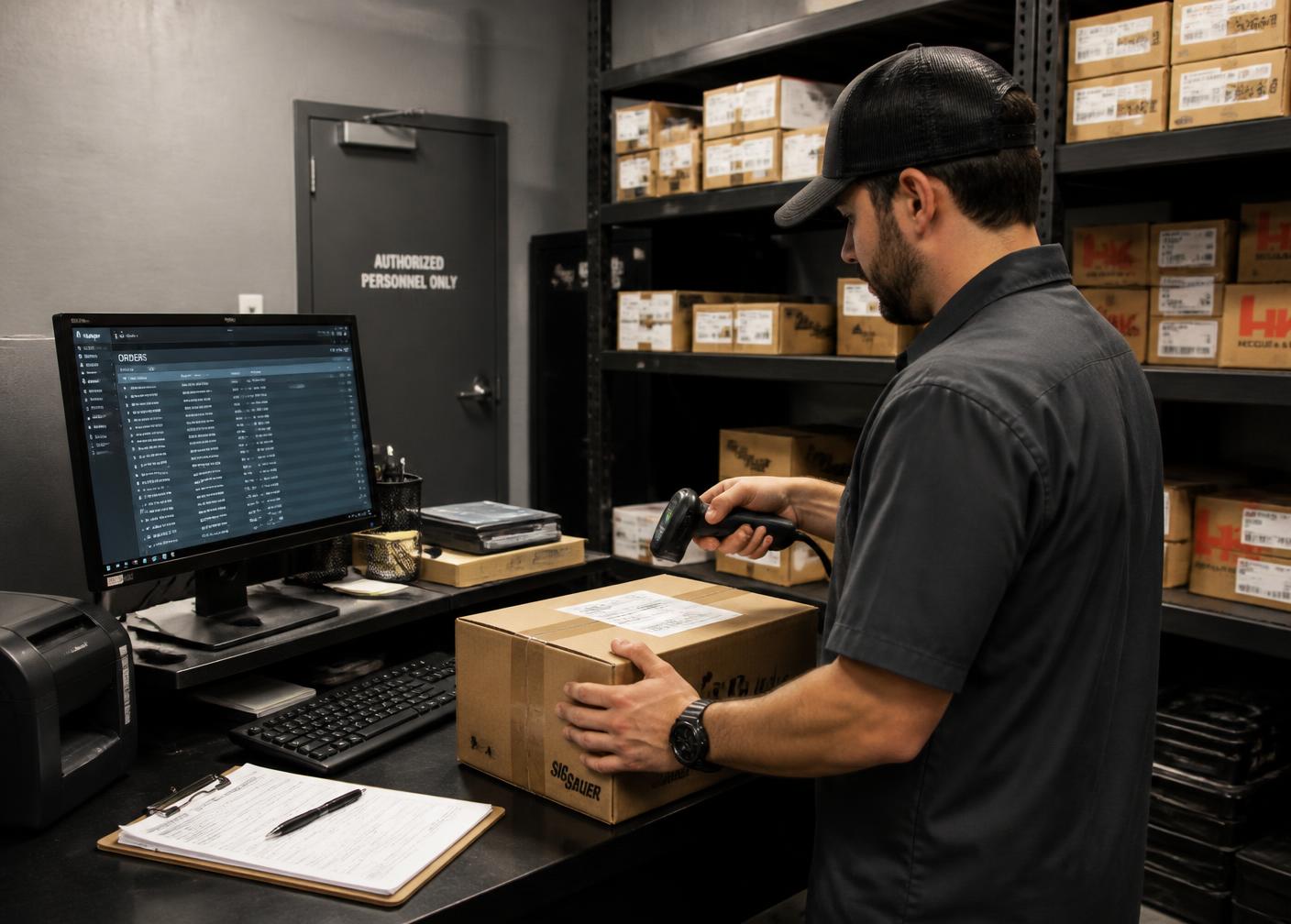
Fulfillment System
FFL Dealer Selection & Locator Systems
The receiving dealer is part of the order, not an afterthought. When selection happens inside checkout, orders stop stalling in an inbox waiting for someone to ask the customer where to ship.
Selection flow
From ZIP code to a verified destination
Every step here is either automated or an email thread. The difference shows up in how long orders sit before they move.
A dealer locator is a small feature with outsized operational effect. Structured dealer data means the shipping address is generated rather than typed, transfer fees can be shown honestly up front, and the store can tell at a glance which orders are waiting on dealer confirmation.
It is also a customer-experience feature. Buyers abandon firearm carts when they cannot tell what happens after they pay — showing the dealer, the fee and the next step removes most of that uncertainty.
Customer location
ZIP, map or saved address
Dealer directory
Name, address, fee, hours, status
Selection at checkout
Chosen dealer stored on the order
License on file
Dealer record confirmed before shipment
Shipping address
Routed to the dealer, not the buyer
Scope
What a working locator includes
The parts that determine whether staff trust it enough to stop double-checking every order.
Proximity search
ZIP, city or map search with results ordered by distance.
Dealer detail
Hours, contact, transfer fee and any handling notes the customer needs.
Preferred dealers
Partners you work with regularly surfaced first.
License records
Structured dealer records held and reviewed by your team.
Order attachment
Selection written to the order and to the shipment address.
Verification queue
Internal list of orders awaiting dealer confirmation.
Change requests
Customer-initiated dealer change with a controlled workflow.
Fee transparency
Transfer fee shown where the customer can see it before paying.
Reporting
Which dealers you ship to most, and where transfers stall.
Method
How we implement dealer selection
- 01
Dealer data model
Name, address, contact, fee, hours and status as fields, not free text.
- 02
Directory sourcing
How the list is populated, reviewed and kept current.
- 03
Locator UX
Search by ZIP or map, with the information a customer needs to choose.
- 04
Checkout integration
Selection stored on the order and shown in confirmation.
- 05
Verification workflow
Internal step for confirming the dealer record before shipment.
- 06
Change handling
A supported path for a customer who picked the wrong dealer.
Dealer selection is a checkout feature of FFL ecommerce and the first input to transfer workflows. It also affects dispute evidence, because the dealer record is part of the delivery story.
Experience
Where dealer selection usually breaks
Free-text fields
A typed dealer name is not an address; it becomes a manual lookup every time.
Stale directories
A list built once and never reviewed sends packages to closed businesses.
Hidden fees
A transfer fee discovered at pickup produces complaints and occasional disputes.
No change path
Customers move and change their minds; without a workflow, staff absorb it.
Multi-location firearm retail · WooCommerce · FFL Cockpit
Armory 219
The product catalog was rebuilt in WooCommerce so serialized firearms, accessories and ammunition each behaved according to their own rules, with location-aware availability instead of a single undifferentiated stock number.
Read the case study →How we report results
We publish what was built and how the business operates afterwards. Client revenue, traffic and ranking figures are only published with the operator's written approval.
All case studies →Answers
Common questions
- How does FFL dealer selection work at checkout?
- The customer searches for a receiving dealer near them, picks one, and that dealer is stored on the order as structured data. The shipment is then addressed to the dealer rather than the buyer, and the store knows in advance where the item is going.
- Should customers choose the dealer before or after payment?
- Both patterns exist. Selecting before payment produces fewer stalled orders because the destination is known at the moment of purchase; selecting after payment reduces checkout friction but shifts work to staff. We usually recommend in-checkout selection with a post-purchase change path.
- Who maintains dealer license records?
- The store does, as part of its own record keeping. Our role is to make the record structured and attached to the order rather than living in an inbox, so the operational side is consistent. What must be collected and retained is a question for your counsel.
Proof
This work, in real firearm businesses
Documented implementations — what was built and how the business runs afterwards. No modelled or estimated performance figures.
Multi-location firearm retail · WooCommerce · FFL Cockpit
Armory 219
The product catalog was rebuilt in WooCommerce so serialized firearms, accessories and ammunition each behaved according to their own rules, with location-aware availability instead of a single undifferentiated stock number.
Read the case study →Local retail + national ecommerce · WooCommerce · FFL Cockpit
USA Gun Store
Firearms, ammunition, optics, parts and accessories were structured with consistent taxonomy, attributes and filtering so that a large catalog stays navigable for customers and legible to search engines.
Read the case study →
Systems Assessment
Capture the dealer at checkout
We implement structured dealer selection so orders arrive with a verified destination instead of a question.