Gun Store Payment Processing
Processing across both channels a firearm business actually sells in: card-present at the counter and card-not-present online, on terms that hold up over time.
View service →
System 02 — Payment
Accepting payments in firearm retail is more complicated than standard ecommerce — not because the law is unclear, but because processors, banks, gateways and platforms each maintain their own policies. The Payment System is about building a stack where all of them agree.
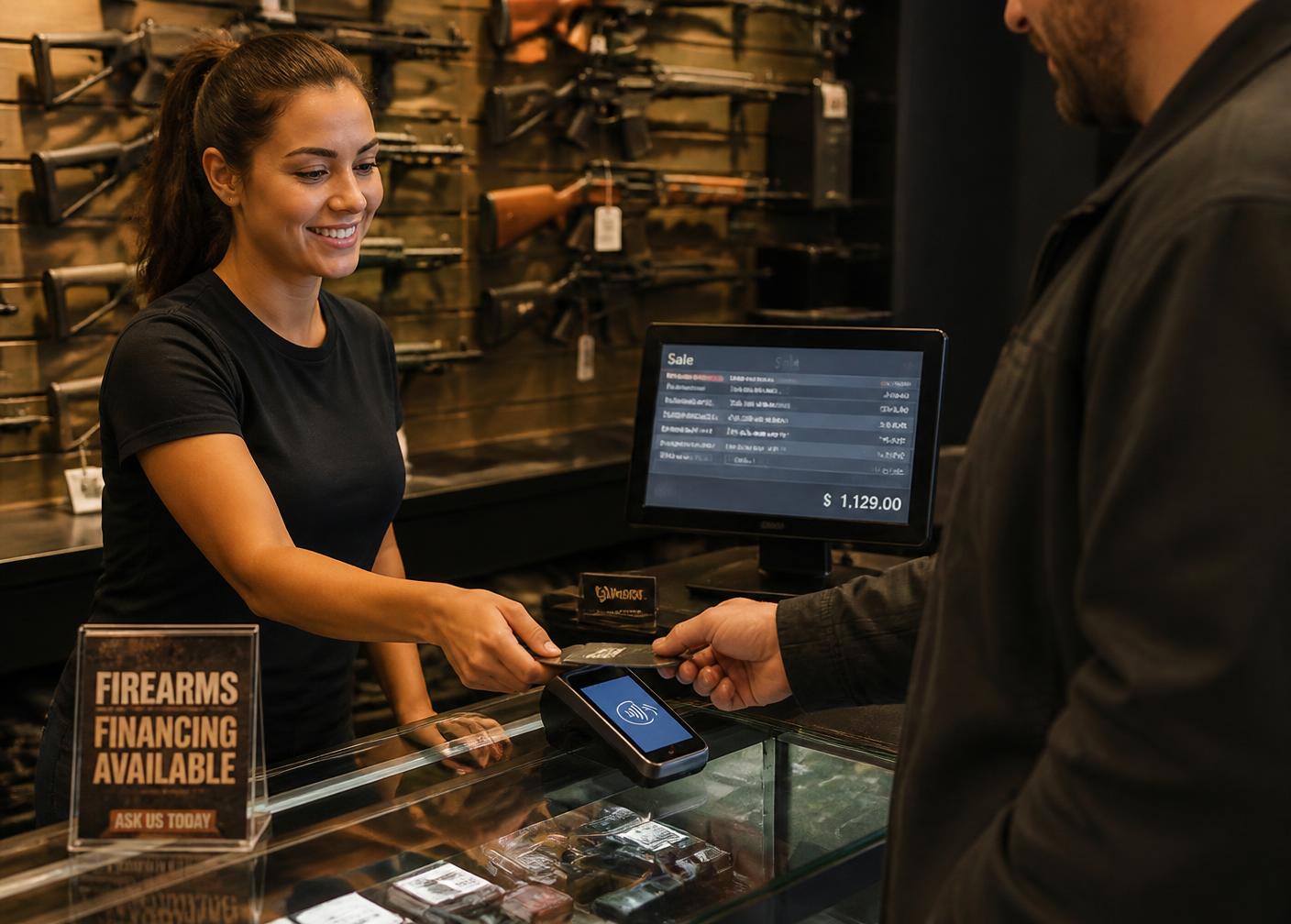
Payment in the store
Card-present and card-not-present transactions live in different systems until the payment stack is built to reconcile them.
Transaction
ConceptualCard present
Transaction flow
Online and in-store transactions diverge at the point of capture and converge again at the gateway. Problems usually appear where one path was configured and the other was assumed.
We use precise language here on purpose. Not every firearm merchant is classified as high risk, and anyone who tells you otherwise is selling a rate. What is true is that underwriting outcomes vary by provider, and that a placement made without disclosing the catalog is a placement waiting to be reversed.
The goal is firearm-friendly processing with appropriate underwriting and confirmed compatibility between processor, gateway, cart and POS — so an approval today does not become a frozen account next quarter.
Ecommerce path
Customer
Website Checkout
Card-not-present
Retail path
Customer
Counter / POS
Card-present
Payment Gateway
Tokenization and routing
Merchant Account
Underwriting and risk profile
Processing
Authorization and capture
Settlement
Funds in your account
Inside the system
Processing across both channels a firearm business actually sells in: card-present at the counter and card-not-present online, on terms that hold up over time.
View service →Account structure and underwriting handled with the catalog disclosed up front, including reserves, volume expectations and MCC selection.
View service →Online checkout processing that is compatible with your cart, your catalog and the firearm items inside it.
View service →Options when an aggregator terminates or an underwriter declines, with clear tradeoffs on rate, reserve and settlement timing.
View service →Gateway selection and integration into the cart and POS, including tokenization and how refunds and voids behave.
View service →Counter hardware and processing connected to the same ledger as the website, so reporting is not reassembled by hand.
View service →Dispute workflows, representment evidence and fraud screening tuned to firearm order patterns and transfer timelines.
View service →Risk
Most payment emergencies in this industry are predictable months before they happen.
Acceptable use policies differ from the law. A processor may permit ammunition but not complete firearms, or permit in-store but not online sales.
Certain categories — such as specific parts, magazines or serialized items — appear on prohibited lists even when they are legally sold. Catalog scope belongs in the underwriting conversation.
A firearm-friendly merchant account is only useful if it connects to a gateway that connects to your cart. Compatibility is the constraint more often than approval is.
Some ecommerce platforms restrict which payment apps can be used with firearm catalogs, which narrows the viable combinations further.
Transfer timelines stretch the gap between charge and delivery, which affects dispute exposure and the evidence you need to keep.
Switching processors touches the cart, POS, subscriptions, saved cards and reporting at once. It should be sequenced, not attempted on a Friday.
Connections
A payment stack is a component of the business, not a vendor relationship that lives on its own.
Payments touch ecommerce at checkout, the POS and operating layer at the counter, and the fulfillment system when an order is captured before a dealer is confirmed or a distributor item turns out to be unavailable. Each of those seams is where money gets stuck.
When the same transaction is represented consistently across cart, gateway, POS and accounting, refunds stop becoming research projects and daily reconciliation stops being someone's evening.
Experience
Disclosure first
We document exactly what the business sells, in which channels, at what volume, before an application is submitted. Undisclosed catalogs are the most common cause of later account reviews.
Compatibility mapped end to end
Processor, gateway, cart, POS and any subscription or deposit workflow are checked against each other rather than approved in isolation.
Failure planning
We look at what happens if the primary processor terminates: what the fallback is, how long it takes to activate, and which data has to move with it.
Local retail + national ecommerce · WooCommerce · FFL Cockpit
Payments were placed with firearm-friendly processing so that online and in-store sales run through infrastructure that will not be withdrawn for selling exactly what the business is licensed to sell.
Read the case study →How we report results
We publish what was built and how the business operates afterwards. Client revenue, traffic and ranking figures are only published with the operator's written approval.
All case studies →Processing and gateway relationships
Firearm-friendly processing through Payroc, with Authorize.Net and Cybersource gateway integrations — Cybersource for enterprise-level deployments that need advanced fraud and multi-entity handling.



Answers
Related systems
Checkout, order routing and reporting all read from the same transaction.
Proof
Documented implementations — what was built and how the business runs afterwards. No modelled or estimated performance figures.
Local retail + national ecommerce · WooCommerce · FFL Cockpit
Payments were placed with firearm-friendly processing so that online and in-store sales run through infrastructure that will not be withdrawn for selling exactly what the business is licensed to sell.
Read the case study →Integral suppressed builds & SD conversions · topical authority
The path from research to enquiry to order was shaped for a high-consideration, high-ticket purchase instead of a generic add-to-cart flow.
Read the case study →Systems Assessment
We map processor, gateway, cart and POS compatibility, look at dispute exposure, and tell you where the account is fragile before it becomes urgent.