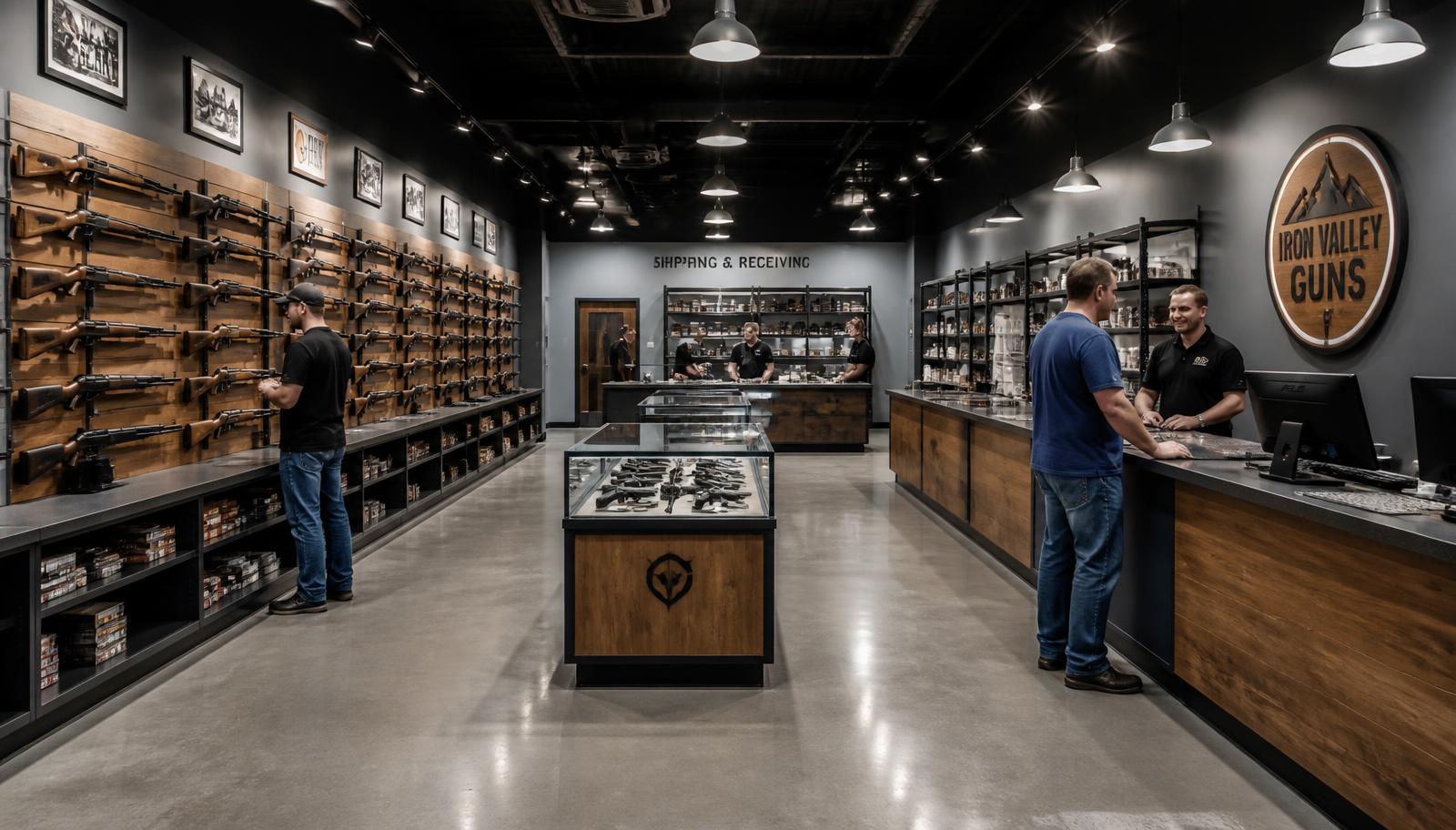
Gun Store SEO
Organic rankings across storefront and catalog: technical SEO, category and product visibility, local search relevance and the ecommerce architecture underneath it.
Explore gun store SEO →
System 01 — Growth
Growth is more than traffic. The Growth System connects visibility, traffic, website experience, conversion and revenue into one chain — and works inside the advertising restrictions the firearms industry actually operates under.
Growth in the store
Search, local listings and AI answers decide who shows up at the counter and who lands on your product page.
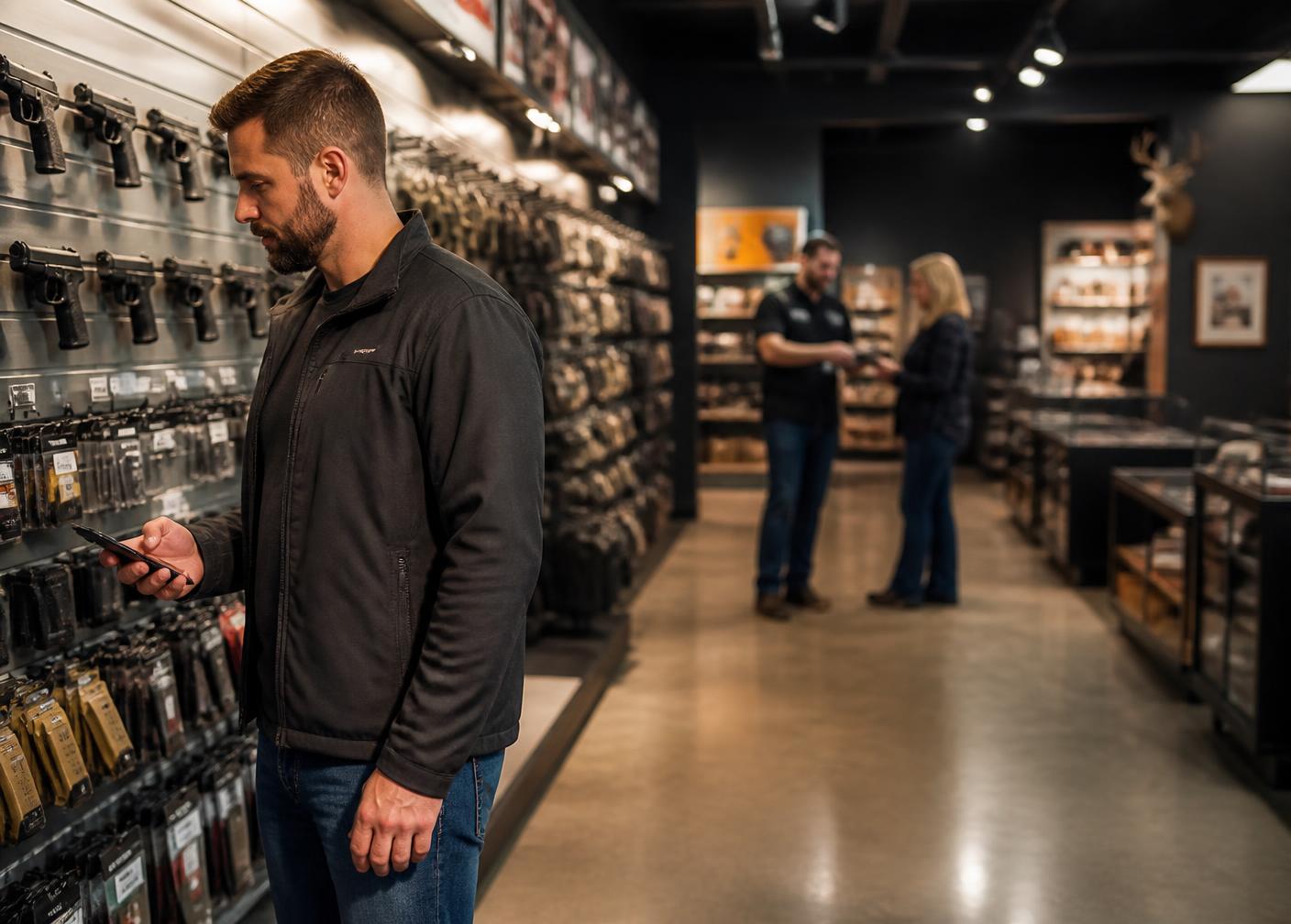
Discovery
ConceptualDemand path
The chain
Each stage is only as strong as the one before it. Ranking a category page that loads slowly on mobile produces traffic, not revenue.
Firearm growth work has constraints most agencies never encounter: restricted ad platforms, ecommerce platforms with policy limits, catalogs in the tens of thousands of SKUs, split local and national intent, product feeds that duplicate the same manufacturer copy across every competitor, and buyers who research on mobile long before they transact.
Because paid channels are unreliable here, the compounding assets — search architecture, catalog quality, content authority and conversion — carry more of the load than they would in almost any other retail category.
Inside the system
Each capability has a distinct job. They are sequenced, not sold as a bundle.
Organic rankings across storefront and catalog: technical SEO, category and product visibility, local search relevance and the ecommerce architecture underneath it.
Explore gun store SEO →Distributor feed duplication, manufacturer copy, variant sprawl, out-of-stock handling, filters and product schema at catalog scale.
See how catalog-scale SEO works →Google Business Profile, Maps visibility and store-level relevance for the searches that end in someone walking through your door.
Get found in local & Maps search →Authority, entity clarity and content structure that make a firearm business understandable to Google AI Overviews, ChatGPT, Gemini and Perplexity.
Learn how AI search visibility is built →A website that has to carry organic discovery, ecommerce, inventory, trust and mobile conversion at the same time — not a brochure.
See our gun store web design approach →Platform builds for the requirements generic carts skip: dealer selection, distributor feeds, serialized items and mixed carts.
Explore firearm ecommerce development →Traffic without conversion is wasted spend. Navigation, product discovery, on-site search, mobile usability, checkout, trust and calls to action.
Turn more traffic into orders →Expertise-based content — caliber guides, comparisons, buyer education — that earns rankings and citations instead of filling a posting quota.
See our firearms content strategy →Turning staff knowledge, range footage and product walkthroughs into assets that support search, product pages and email.
Explore video marketing for gun stores →Reviews as a search and conversion input: capture process, response workflow and where proof appears on the site.
Build reviews & reputation →Industry reality
These are not talking points. They change which tactics are available and which ones are wasted effort.
Major ad platforms restrict or prohibit firearm and ammunition promotion, and enforcement is inconsistent. Paid acquisition cannot be the foundation of the plan.
Ecommerce platforms, apps and processors each maintain their own prohibited-product rules. A stack can be compliant with the law and still be non-compliant with a vendor's terms.
Firearms, ammunition, optics, parts and accessories behave differently in search, in shipping and in checkout — inside the same cart.
The same store competes for 'gun store near me' and for a nationally searched model number. Those need different pages and different signals.
When every dealer publishes identical manufacturer descriptions, product pages compete on structure, speed and authority instead of copy.
Buyers know the vocabulary. Vague, sanitized copy signals that a store does not actually know its products.
Method
SEO, website design, ecommerce and content are usually bought separately and delivered by vendors who never speak. That is why results stall: the SEO recommends a category structure the developer never builds, and the content team writes for keywords the catalog cannot support.
What is indexed, what is crawling budget, and what is invisible.
Category, manufacturer and location structure mapped to real search intent.
Local, national, brand, model and caliber intent assigned to owning pages.
On-page, schema, internal linking and site performance work in priority order.
Content and citations that make the business referenceable, not just present.
Qualified organic sessions, category visibility and revenue — not vanity keyword counts.
Growth also has downstream dependencies. Demand that arrives at a payment system that declines cards, or a fulfillment workflow that stalls at dealer selection, converts into refunds and bad reviews. Once a customer does buy, the retention system decides whether acquisition cost is paid back once or five times.
Experience
Catalog-scale search work
Firearm catalogs behave differently from typical retail sites: feed-driven SKUs, rapid stock churn and thousands of near-duplicate product records. The work is architectural before it is editorial.
Ecommerce and marketing under one roof
Most recommendations fail at implementation. We scope SEO against what the platform, feed and POS can actually support.
Built for restricted channels
Every plan assumes paid firearm advertising may be unavailable tomorrow, so organic, owned and referral assets carry the model.
Multi-location firearm retail · WooCommerce · FFL Cockpit
Each location was given its own indexable location page, structured data and Google Business Profile treatment, so both stores compete in their own local market rather than cannibalising one brand listing.
Read the case study →How we report results
We publish what was built and how the business operates afterwards. Client revenue, traffic and ranking figures are only published with the operator's written approval.
All case studies →Where growth work actually runs
Search, ads and site builds happen inside these platforms — the partnerships and certifications behind that work are held directly by our team.




Answers
Related systems
Demand is only valuable if the rest of the business can absorb it.
Proof
Documented implementations — what was built and how the business runs afterwards. No modelled or estimated performance figures.
Multi-location firearm retail · WooCommerce · FFL Cockpit
Each location was given its own indexable location page, structured data and Google Business Profile treatment, so both stores compete in their own local market rather than cannibalising one brand listing.
Read the case study →Local retail + national ecommerce · WooCommerce · FFL Cockpit
Local intent and catalog intent were separated at the information-architecture level: a local business layer with location, hours and service content, and a category and brand layer built to be crawled, filtered and indexed at national scale.
Read the case study →Systems Assessment
We review search visibility, site architecture, catalog structure, conversion and content authority, then rank what is actually limiting revenue.