Search at catalog scale: category taxonomy, indexation control, manufacturer and model pages, and unique value on product pages that thousands of competitors also list.
- Ecommerce SEO
- Category architecture
- AI search
- CRO
- Content

Who We Help
Build the search, ecommerce, payment, inventory and fulfillment infrastructure required to operate a competitive online firearm business.
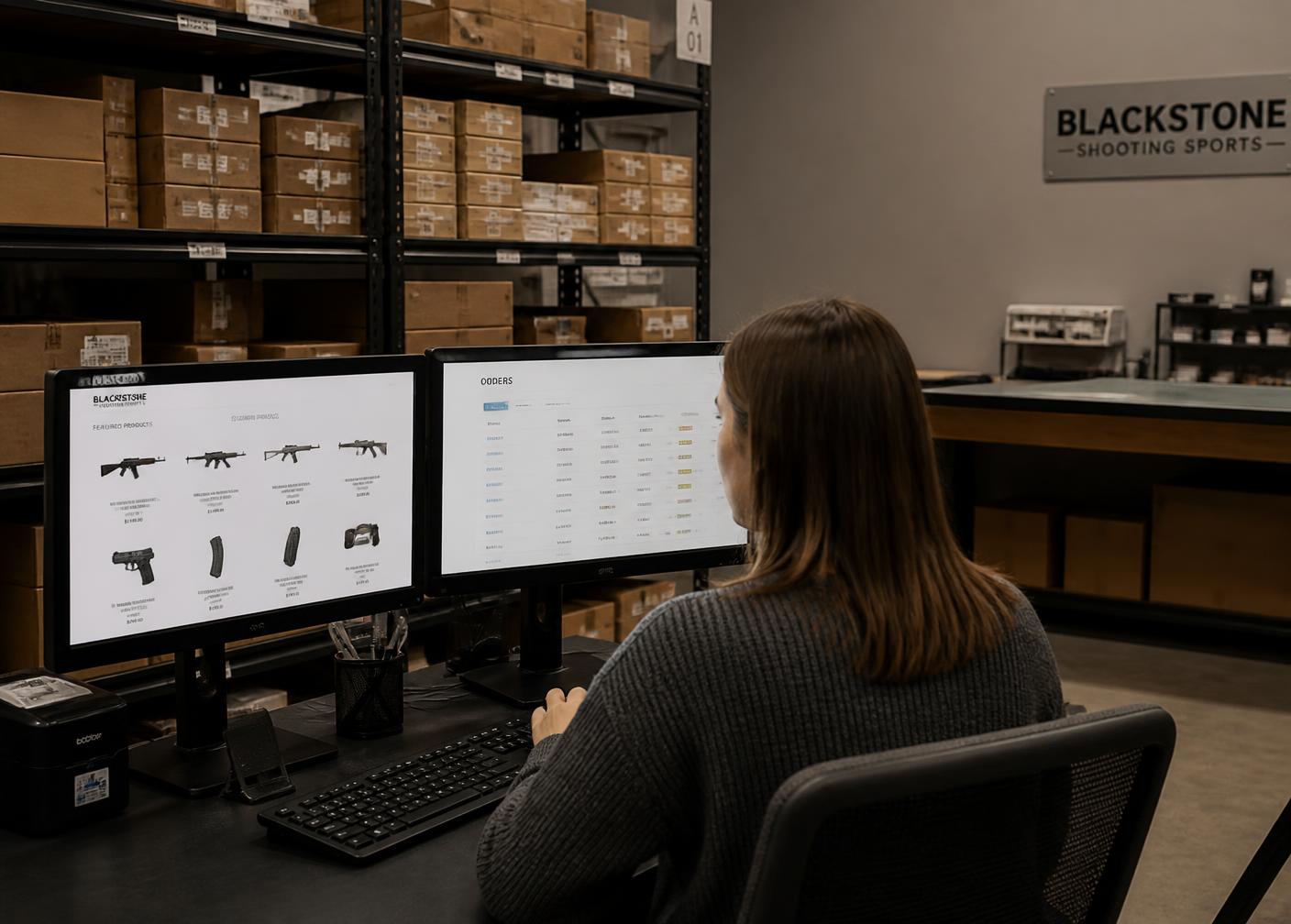
Systems in view
ConceptualThe business model
Traffic is not the bottleneck for most online firearm retailers. The catalog, the checkout and the fulfillment path are.
A national firearm retailer depends far more on architecture than a local store does. Every stage of the chain feeds the next: discovery brings people to category and product pages, the catalog decides whether those pages deserve to rank at all, the site decides whether visitors can navigate a five-figure SKU count, payment decides whether the order completes, and fulfillment decides whether the customer ever comes back.
That is why ecommerce work in this category rarely stays inside one discipline. A slow category page is a development problem, a duplicate product page is a data problem, and a stalled order is an operations problem — and all three show up as "our conversion rate is low."
Search & AI discovery
Category, product and comparison intent
Product catalog
Distributor feeds, variants, availability
Website & navigation
Filtering, speed, product detail
Payment
Firearm-compatible processing
FFL & fulfillment
Dealer selection, routing, shipping
Retention
Email, CRM, repeat purchase
A weak link anywhere in the chain caps everything downstream of it.
The Five Systems
Compared with a retail store, weight shifts hard toward Fulfillment and the technical side of Growth.
Search at catalog scale: category taxonomy, indexation control, manufacturer and model pages, and unique value on product pages that thousands of competitors also list.
Online-only volume makes processing stability existential. Underwriting fit, gateway compatibility with the cart, and dispute handling at volume all matter.
The distinguishing system. Distributor feeds, availability, dealer selection inside checkout, routing rules and order status all sit here.
Acquisition costs in this category are high and rising. Repeat purchase of ammunition, accessories and optics is where margin recovers.
At volume, manual work becomes the ceiling. Reporting, automation and integrations decide how many orders a team can handle without adding headcount.
Search
Catalog SEO is mostly a series of decisions about what should exist as an indexable page. Product indexing has to be selective. Category architecture has to match how buyers actually narrow down — by platform, caliber, manufacturer and use case, not by whatever taxonomy the distributor exported. Manufacturer pages are frequently the highest-value pages on the site and the least developed.
Then there is the maintenance layer: filters that generate crawlable combinations, out-of-stock products that vanish and return, and discontinued items that still hold links. Those need rules, not one-time cleanups. See Firearms Ecommerce SEO.
Whether the current platform can carry the catalog, the FFL checkout requirements and the feed volume — or whether it is quietly capping the business.
Firearms Ecommerce Development →Online firearm checkout depends on processing that is underwritten for the category and integrated with the cart rather than bolted beside it.
Ecommerce Payment Processing →Dealer selection, transfer workflow, distributor routing and order automation are what turn a completed checkout into a delivered firearm.
FFL Ecommerce →Inventory sources
Local
Physical stock you control, count and can ship today.
Warehouse
Owned inventory held off-site or across locations.
Distributor
Feed-driven availability you do not control and cannot fully trust in real time.
Most online catalog problems are really precedence problems: which source wins when they disagree, how stale a distributor number is allowed to be before it stops being shown as in stock, and what happens to a product page when every source drops to zero. Distributor integrations and inventory integration cover the mechanics.
Retention & automation
Without a storefront, there is no walk-in habit to fall back on. Repeat purchase has to be engineered: post-purchase sequences that arrive while the customer is waiting on a transfer, ammunition and accessory follow-ups tied to what they actually bought, and reactivation for buyers who have gone quiet. That work lives in the Retention System.
Automation is the other half. As order volume grows, the manual steps — routing, status updates, dealer verification chasing, distributor submissions — grow with it. Order automation and business automation exist to keep headcount from being the only way to scale.
What we usually find
Answers
Related services
Each service page covers the specific implementation detail behind these systems.
Distributor feed duplication, variants, out-of-stock and discontinued product handling.
Platform builds that survive FFL checkout, serialized items and feed volume.
Online checkout processing compatible with firearm catalogs.
Compliant online firearm checkout end to end.
RSR, Lipsey's, Sports South and similar feed connections.
Order routing, drop-ship and exception handling.
Other business models
Proof
Documented implementations — what was built and how the business runs afterwards. No modelled or estimated performance figures.
Multi-location firearm retail · WooCommerce · FFL Cockpit
Two retail locations, a live firearm catalog and a transfer operation, unified behind one ecommerce, inventory and marketing system instead of three disconnected tools.
Read the case study →Local retail + national ecommerce · WooCommerce · FFL Cockpit
A family-run Wynne, Arkansas retailer running a large national firearms and ammunition catalog — two very different businesses served by a single ecommerce, fulfillment and search architecture.
Read the case study →Systems Assessment
We evaluate your growth, ecommerce, payment, fulfillment, retention and operating systems, then show you where the biggest opportunities are.