
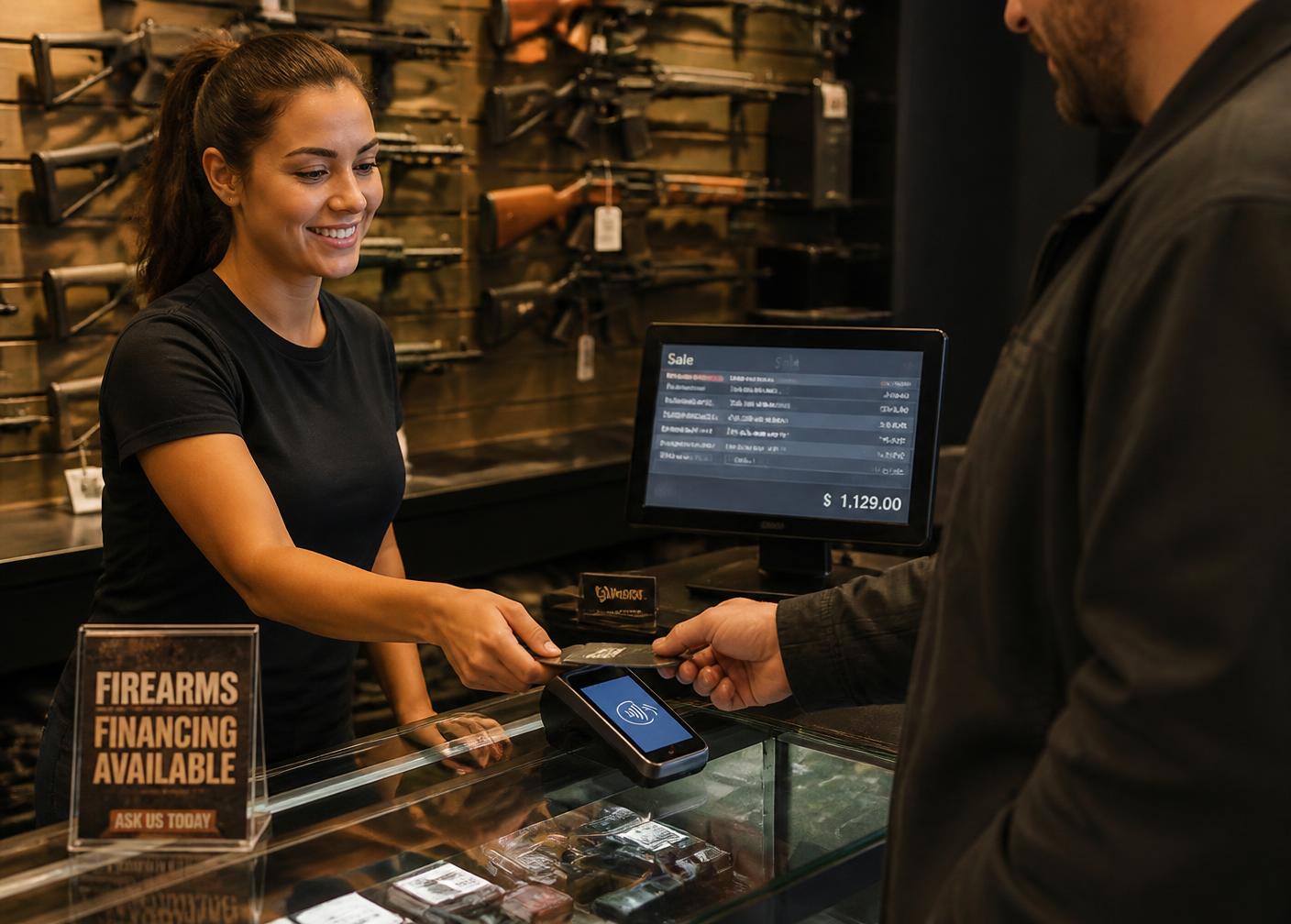
Payment System
Payment Processing for Gun Stores & FFLs
A firearm business needs processing that works at the counter and online — and that stays in place. Most payment failures in this industry are onboarding decisions coming due months later.
How it works
Two channels, one settlement chain
Card-present and card-not-present transactions take different paths to the same merchant account. Both have to be approved for what you actually sell.
Accepting a card involves a chain of parties: the terminal or checkout, a gateway, a merchant account, a processor and the settlement bank. Firearm retail is not unusual in the mechanics — it is unusual in that several links in that chain publish their own policy about the products you sell.
That is why we start with your statements and your catalog rather than a rate sheet. Placement that survives underwriting review is worth more than a few basis points.
Card present
Counter terminal
EMV, tap, chip
POS system
Ticket, tender, receipt
Card not present
Online checkout
Cart, tokenized card
Gateway
Auth, capture, refund
Merchant account
Underwritten for firearm MCC
Settlement & funding
Batch, reserve, deposit
Scope
What we handle
Processing work spans both sides of the business, because most firearm retailers run both.
Counter processing
Terminals, pin pads and tender flow connected to the point of sale.
Online processing
Checkout capture for carts that include firearms, ammunition and accessories.
Underwriting support
Applications prepared with catalog, volume and channel disclosed.
Rate and fee analysis
Effective rate, interchange handling, and the fees buried under it.
Reserve terms
Rolling reserves, funding delays and how they affect working capital.
Gateway fit
Confirming the account connects to the cart and POS you actually run.
Phone and layaway
MOTO, deposits and stored credentials handled deliberately.
Reconciliation
Deposits that match tickets without a spreadsheet rebuild each morning.
Contingency
A documented plan if a provider changes policy mid-relationship.
Method
How we set up processing
- 01
Statement review
Current rates, fees, reserve terms and effective cost per channel.
- 02
Catalog and channel mapping
What you sell, where you sell it and which items providers treat differently.
- 03
Provider shortlist
Processors that accept the catalog and connect to your cart and POS.
- 04
Disclosed application
Underwriting submitted with the firearm business stated plainly up front.
- 05
Integration
Gateway, cart and terminal configuration, tested with real transaction types.
- 06
Cutover
Sequenced migration of saved cards, recurring charges and reporting.
- 07
Monitoring
Deposits, disputes and reserve behavior watched through the first cycles.
Processing does not sit on its own. It connects to your gateway, your POS and your ecommerce platform — and the account underneath it is a merchant account with its own terms.
Experience
What we look at that generalists miss
Catalog scope
Complete firearms, receivers, ammunition, magazines and certain parts are treated differently by different providers.
Channel mix
A store that is 80% counter and 20% online underwrites differently than the reverse.
Transfer timing
The gap between charge and possession affects dispute exposure and capture strategy.
Platform limits
Some ecommerce platforms restrict which payment apps may be used with firearm catalogs.
Local retail + national ecommerce · WooCommerce · FFL Cockpit
USA Gun Store
Payments were placed with firearm-friendly processing so that online and in-store sales run through infrastructure that will not be withdrawn for selling exactly what the business is licensed to sell.
Read the case study →How we report results
We publish what was built and how the business operates afterwards. Client revenue, traffic and ranking figures are only published with the operator's written approval.
All case studies →Answers
Common questions
- Can gun stores accept credit cards?
- Yes. Firearm sales are legal commerce and card networks do not prohibit them. What varies is individual provider policy: some processors and aggregators exclude firearm merchants in their acceptable use terms, so the account has to be placed with a provider that knowingly accepts the business.
- Why did a processor shut down a gun store account?
- Almost always because the catalog was never disclosed during onboarding, or it changed after approval. An automated review flags firearm SKUs, the account is matched against the acceptable use policy, and the merchant is offboarded — sometimes with funds held during the reserve period.
- What does it cost to process payments for a firearm business?
- Rates depend on channel mix, average ticket, volume, chargeback history and how the account is underwritten. Card-present processing generally prices better than card-not-present. We do not quote rates without seeing statements, because a rate quoted blind is a sales tactic rather than an answer.
Keep going
Related services
Proof
This work, in real firearm businesses
Documented implementations — what was built and how the business runs afterwards. No modelled or estimated performance figures.
Local retail + national ecommerce · WooCommerce · FFL Cockpit
USA Gun Store
Payments were placed with firearm-friendly processing so that online and in-store sales run through infrastructure that will not be withdrawn for selling exactly what the business is licensed to sell.
Read the case study →Integral suppressed builds & SD conversions · topical authority
Ronin Arms
The path from research to enquiry to order was shaped for a high-consideration, high-ticket purchase instead of a generic add-to-cart flow.
Read the case study →
Systems Assessment
Find out whether your processing will hold
We review statements, underwriting posture, gateway compatibility and dispute exposure, then give you a prioritized plan — not a rate quote.