
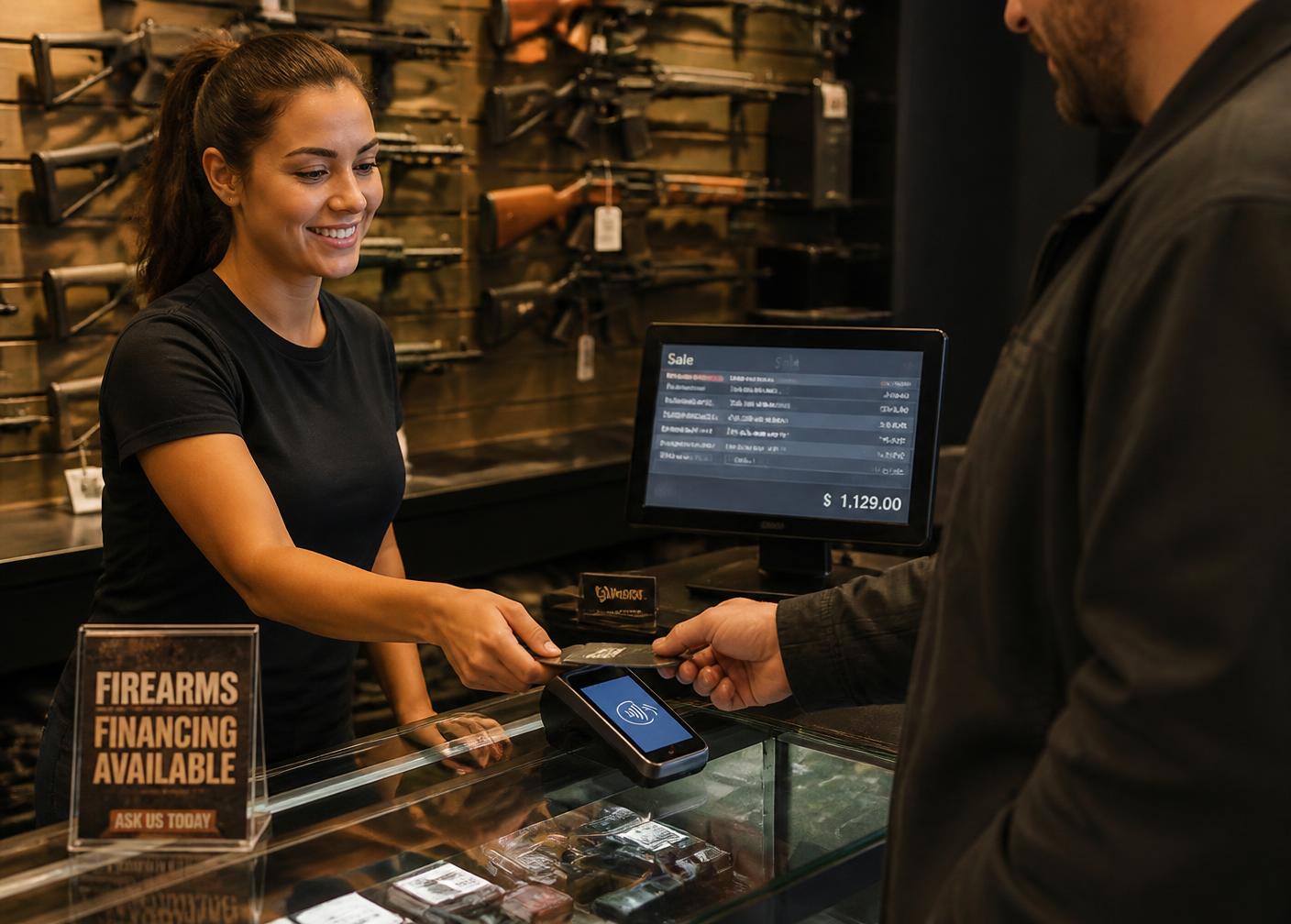
Payment System
Firearms-Friendly & High-Risk Payment Processing
If an aggregator has terminated you or an underwriter declined the application, the question is not whether firearm businesses can process cards. It is which provider will knowingly accept your catalog, and on what terms.
Placement
Four ways a firearm business gets boarded
Each option trades speed against durability. The fastest onboarding is usually the one most likely to close the account later.
We use precise language here on purpose. High risk is how an acquirer prices uncertainty, not a judgment about your business. What matters is whether the provider has looked at your catalog and said yes in writing.
The durable answer is usually a disclosed direct account, with a second boarded provider held in reserve so a policy change never becomes a shutdown.
Aggregator
Fast onboarding, firearm catalogs commonly prohibited
Standard underwriting
Direct account, firearm business disclosed and accepted
Specialized program
Higher rate or reserve, built for firearm and ammo volume
Backup account
Second boarded processor held in reserve
The right placement is the one that is durable at your volume, not the one with the lowest headline rate.
Reality
Undisclosed placement vs. disclosed placement
Both process cards on day one. They diverge at the first automated review.
Undisclosed / aggregator
- Instant approval with no catalog review
- Firearm products commonly excluded in the terms you accepted
- Automated review can freeze settlements without notice
- Funds held through a reserve period during offboarding
- No recourse — the policy was published before you signed
Disclosed / underwritten
- Slower onboarding with real underwriting
- Catalog reviewed and approved in writing
- Terms priced for the actual risk profile
- Volume growth handled through review, not termination
- A relationship you can call when something changes
Method
Recovering from a termination
- 01
Stabilize
Confirm what is frozen, what still settles, and what the agreement says about reserves.
- 02
Diagnose
Identify the actual trigger: catalog, ratio, volume spike or undisclosed change.
- 03
Shortlist
Providers whose written policy covers your specific products and channels.
- 04
Re-apply properly
A disclosed application that addresses the prior termination directly.
- 05
Re-integrate
Gateway, cart and POS reconnected, with saved credentials migrated where possible.
- 06
Reduce exposure
Dispute and fraud work so the new account does not repeat the pattern.
Placement is one part of the picture. The merchant account terms, gateway compatibility and dispute exposure determine whether the new account is still there in a year.
Experience
How we evaluate a provider
Written policy, not a sales call
The acceptable use policy is the document that decides your future, so we read it.
Reserve math
We model what a rolling reserve does to cash flow at your real volume.
Exit terms
Notice periods and equipment obligations matter when you need to move again.
Redundancy
A second boarded account is cheap insurance compared to a week without processing.
Local retail + national ecommerce · WooCommerce · FFL Cockpit
USA Gun Store
Payments were placed with firearm-friendly processing so that online and in-store sales run through infrastructure that will not be withdrawn for selling exactly what the business is licensed to sell.
Read the case study →How we report results
We publish what was built and how the business operates afterwards. Client revenue, traffic and ranking figures are only published with the operator's written approval.
All case studies →Answers
Common questions
- Are firearm businesses always high risk?
- No. Classification depends on the provider, product mix, chargeback history, channel split and underwriting model. Some firearm retailers are boarded on standard terms. High risk is a placement category, not a legal status.
- What happens when an aggregator terminates an account?
- Processing stops, and settled funds may be held through a reserve period defined in the agreement you accepted at signup. The priority is a compliant replacement account boarded quickly, then an orderly release of held funds.
- What does high-risk processing cost?
- Generally a higher discount rate, sometimes a rolling reserve, occasionally delayed funding. Whether that is expensive depends on the alternative: an account that gets closed costs more than a few extra basis points.
Proof
This work, in real firearm businesses
Documented implementations — what was built and how the business runs afterwards. No modelled or estimated performance figures.
Local retail + national ecommerce · WooCommerce · FFL Cockpit
USA Gun Store
Payments were placed with firearm-friendly processing so that online and in-store sales run through infrastructure that will not be withdrawn for selling exactly what the business is licensed to sell.
Read the case study →Integral suppressed builds & SD conversions · topical authority
Ronin Arms
The path from research to enquiry to order was shaped for a high-consideration, high-ticket purchase instead of a generic add-to-cart flow.
Read the case study →
Systems Assessment
Replace a fragile account before it fails
We identify what triggered the termination, shortlist providers whose policy actually covers your catalog, and sequence the migration.