
Payment System
Payment Gateway Integration
The gateway is where an approved merchant account either becomes a working payment stack or a support ticket. Compatibility is the constraint more often than approval is.
Architecture
Every card endpoint through one gateway
Split gateways create split reporting, split vaults and refunds that cannot be processed by the person taking the call.
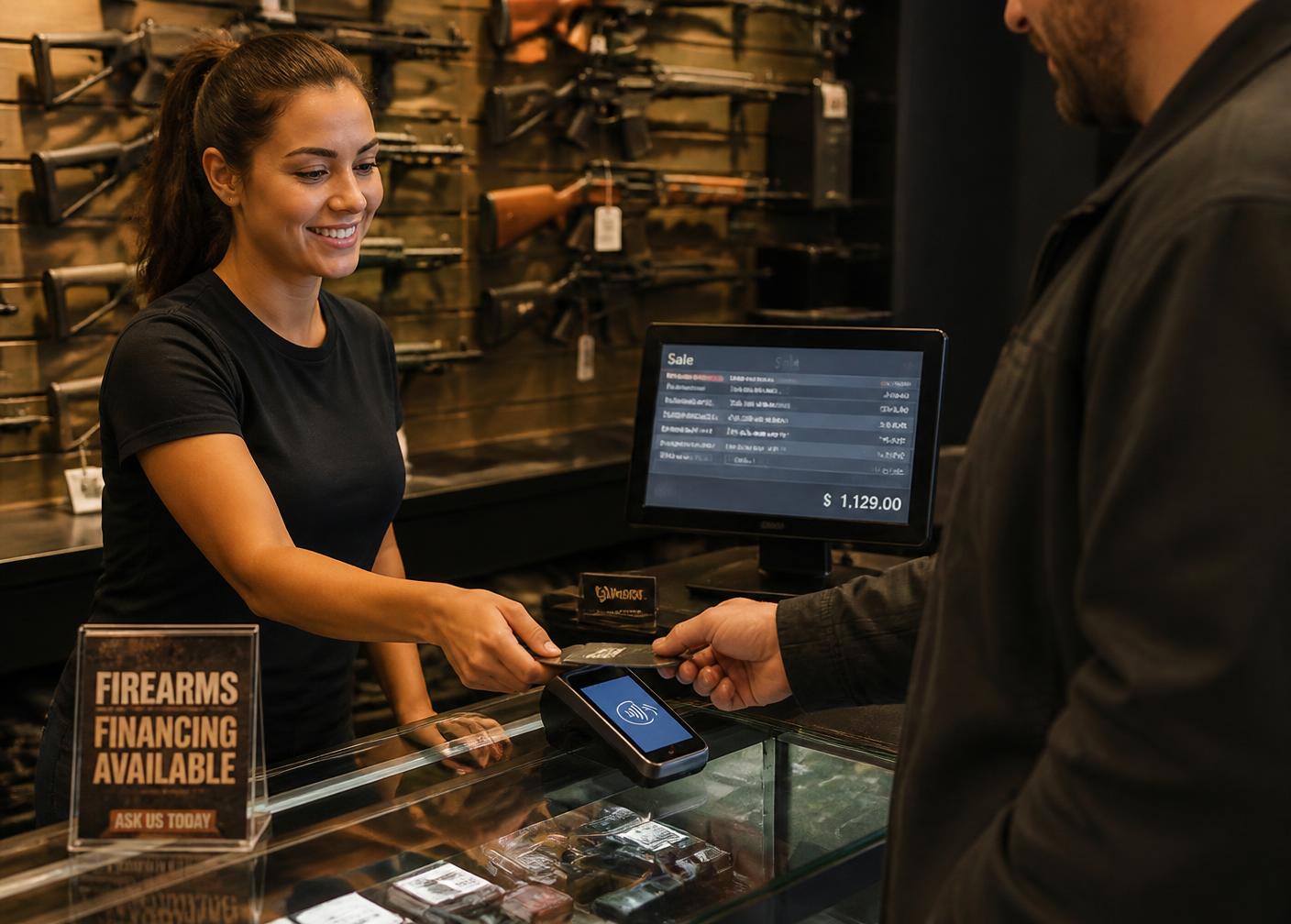
Firearm retailers take cards in more places than most retailers: the counter, the website, over the phone for special orders, and against layaway balances. Each of those is a gateway integration, and each one that lives on its own becomes a reconciliation problem.
We consolidate where the platform allows it and document the seams where it does not.
Website cart
Hosted fields or redirect
POS terminal
Semi-integrated pin pad
Phone / MOTO
Virtual terminal
Layaway & deposits
Stored credentials
Single gateway
One vault, one reporting surface
Refunds
Voids
Reporting
Scope
What integration covers
Gateway work is mostly the unglamorous parts — the ones that surface at month end.
Tokenization
Card data vaulted so repeat customers and layaway balances are chargeable.
Hosted fields
Checkout capture that keeps card data off your servers.
Semi-integrated terminals
Amounts pushed from POS so totals cannot be mistyped.
Virtual terminal
Phone and special-order payments handled with the same reporting.
Refunds and voids
Behavior defined and tested before staff need it at the counter.
3-D Secure
Liability shift configured where it helps without wrecking conversion.
Webhooks
Payment events pushed into order and ledger systems reliably.
Retry logic
Soft declines handled cleanly instead of duplicating charges.
Audit trail
Who ran what, when, and against which order.
Method
How we integrate a gateway
- 01
Inventory the endpoints
Every place a card is taken: cart, counter, phone, layaway, events.
- 02
Compatibility matrix
Gateway against platform, POS and merchant account — confirmed, not assumed.
- 03
Integration build
Hosted fields, tokenization and semi-integrated terminal connections.
- 04
Edge-case testing
Partial captures, voids, refunds, expired auths and declined retries.
- 05
Vault migration
Stored credentials moved without forcing customers to re-enter cards.
- 06
Reporting
One transaction view that reconciles against deposits and POS totals.
Gateway work connects online checkout, counter payments and the operating layer where reporting and reconciliation live.
Experience
What we test before go-live
Refund parity
A refund issued online should be visible and reconcilable at the counter.
Auth expiry behavior
What happens to a held order when the authorization window closes.
Vault portability
Whether stored cards can move if the processor changes later.
Failure modes
Gateway downtime handling, so the counter is not stopped by an outage.
Local retail + national ecommerce · WooCommerce · FFL Cockpit
USA Gun Store
Payments were placed with firearm-friendly processing so that online and in-store sales run through infrastructure that will not be withdrawn for selling exactly what the business is licensed to sell.
Read the case study →How we report results
We publish what was built and how the business operates afterwards. Client revenue, traffic and ranking figures are only published with the operator's written approval.
All case studies →Answers
Common questions
- What does a payment gateway actually do?
- It transmits card data securely between your checkout or terminal and the processor, tokenizes stored credentials, and returns authorization results. The merchant account decides whether you can process; the gateway decides what you can process it with.
- Can we keep our gateway if we change processors?
- Sometimes. Some gateways are processor-agnostic and can be repointed; others are tied to a single acquirer. Where the gateway can stay, migrating saved cards and recurring charges is far simpler.
- Do we need separate gateways for online and in-store?
- Not necessarily, and usually you should not want to. A single gateway across cart, counter and phone orders gives one vault and one reporting surface, which is what makes reconciliation manageable.
Proof
This work, in real firearm businesses
Documented implementations — what was built and how the business runs afterwards. No modelled or estimated performance figures.
Local retail + national ecommerce · WooCommerce · FFL Cockpit
USA Gun Store
Payments were placed with firearm-friendly processing so that online and in-store sales run through infrastructure that will not be withdrawn for selling exactly what the business is licensed to sell.
Read the case study →Integral suppressed builds & SD conversions · topical authority
Ronin Arms
The path from research to enquiry to order was shaped for a high-consideration, high-ticket purchase instead of a generic add-to-cart flow.
Read the case study →
Systems Assessment
One gateway, one vault, one set of numbers
We map every place you take a card, confirm compatibility across platform, POS and processor, and consolidate what can be consolidated.